
UPSSSC PET Syllabus and Exam Pattern 2026
The Uttar Pradesh Subordinate Service Selection Commission (UPSSSC) conducts the Preliminary Eligibility Test (PET) as a mandatory screening exam for Group B and Group C posts in Uttar Pradesh. Before appearing for any UPSSSC recruitment, candidates must qualify PET, which makes the UPSSSC PET syllabus and exam pattern 2026 the starting point of preparation. This article covers the subject-wise syllabus, marks distribution, negative marking rule, selection process, and a preparation strategy based on the official exam structure.
UPSSSC PET एक जरूरी प्रारंभिक परीक्षा है जो यूपी में ग्रुप B और C पदों के लिए भर्ती से पहले देनी होती है। इसका syllabus और exam pattern समझना तैयारी की शुरुआत के लिए बहुत जरूरी है।
Source
Vacancy/Update Name: UPSSSC PET Syllabus and Exam Pattern 2026 – Overview
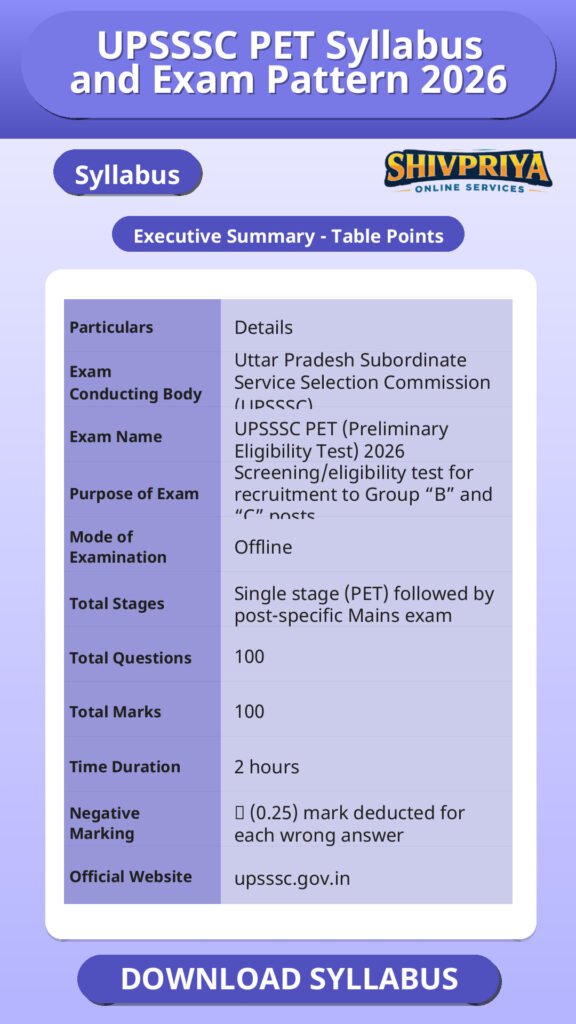
UPSSSC PET Syllabus and Exam Pattern 2026 – Overview
| Particulars | Details |
|---|---|
| Exam Conducting Body | Uttar Pradesh Subordinate Service Selection Commission (UPSSSC) |
| Exam Name | UPSSSC PET (Preliminary Eligibility Test) 2026 |
| Purpose of Exam | Screening/eligibility test for recruitment to Group “B” and “C” posts |
| Mode of Examination | Offline |
| Total Stages | Single stage (PET) followed by post-specific Mains exam |
| Total Questions | 100 |
| Total Marks | 100 |
| Time Duration | 2 hours |
| Negative Marking | ¼ (0.25) mark deducted for each wrong answer |
| Official Website | upsssc.gov.in |
यह परीक्षा एक बार में 100 प्रश्नों की होती है, जो ऑफलाइन आयोजित होती है। इसमें गलत जवाब देने पर 0.25 अंक काटे जाते हैं। यह परीक्षा ग्रुप B और C की भर्ती के लिए जरूरी योग्यता तय करती है।
UPSSSC PET Selection Process 2026
UPSSSC PET is not a standalone recruitment exam it is the first filter that decides eligibility for a range of Group B and C posts. The selection process typically works as follows:
- Stage 1 – PET (Preliminary Eligibility Test): Candidates must appear for and qualify the PET, which is a common eligibility test for multiple posts under UPSSSC.
- Stage 2 – Post-wise Mains/Recruitment Exam: Once a candidate has a valid PET score, they become eligible to apply for individual UPSSSC recruitment notifications (such as Lekhpal, Junior Assistant, Excise Constable, etc.). Each of these posts conducts its own Mains exam or further selection stage.
- Document Verification/Physical Tests (post-specific): Depending on the post applied for, candidates may also need to clear document verification, physical standard tests, or skill tests as prescribed in that post’s own notification.
PET पास करना जरूरी है क्योंकि इसके बिना ग्रुप B और C पदों की मुख्य परीक्षा में बैठना संभव नहीं है। PET क्वालीफाई करने के बाद ही उम्मीदवार अलग-अलग पदों के लिए आवेदन कर सकते हैं, जहां मुख्य परीक्षा और दस्तावेज़ जांच होती है।
UPSSSC PET Exam Pattern 2026
PET Exam Pattern – Key Rules
- The exam consists of objective-type multiple-choice questions (MCQs) only.
- A total of 100 questions are asked, carrying 100 marks in all.
- The total duration of the exam is 2 hours.
- Each wrong answer results in a negative marking of ¼ (0.25) mark.
- The difficulty level of questions is based on the NCERT Secondary/Senior Secondary syllabus, as indicated in the source material.
सभी प्रश्न MCQ होंगे और NCERT के हाई स्कूल स्तर के होंगे। समय 2 घंटे है, इसलिए समय प्रबंधन और सावधानी से जवाब देना जरूरी है, खासकर क्योंकि गलत जवाब पर नकारात्मक अंकन भी है।
Subject-Wise Marks Distribution
| S. No. | Subject | Questions | Marks |
|---|---|---|---|
| 1 | Indian History | 5 | 5 |
| 2 | Indian National Movement | 5 | 5 |
| 3 | Geography | 5 | 5 |
| 4 | Indian Economy | 5 | 5 |
| 5 | Indian Constitution & Public Administration | 5 | 5 |
| 6 | General Science | 5 | 5 |
| 7 | Elementary Arithmetic | 5 | 5 |
| 8 | General Hindi | 5 | 5 |
| 9 | General English | 5 | 5 |
| 10 | Logic & Reasoning | 5 | 5 |
| 11 | Current Affairs | 10 | 10 |
| 12 | General Awareness | 10 | 10 |
| 13 | Analysis of Hindi Unread Passage (2 passages) | 10 | 10 |
| 14 | Graph Interpretation (2 graphs) | 10 | 10 |
| 15 | Table Interpretation & Analysis (2 tables) | 10 | 10 |
| Total | 100 | 100 | |
कुल 15 विषयों से 100 प्रश्न पूछे जाते हैं, जिनमें करंट अफेयर्स, सामान्य जागरूकता, और डेटा इंटरप्रिटेशन जैसे विषयों का वज़न ज्यादा है। इन विषयों पर विशेष ध्यान देना लाभदायक होगा।
UPSSSC PET Syllabus 2026
The UPSSSC PET syllabus is divided into 15 sections, covering general awareness, history, geography, economy, polity, science, language, reasoning, and data interpretation topics. Below is the detailed subject-wise topic list.
सिलेबस में इतिहास, भूगोल, अर्थव्यवस्था, भारतीय संविधान, विज्ञान, भाषा, तर्कशक्ति और डेटा विश्लेषण जैसे विषय शामिल हैं, जो व्यापक ज्ञान मांगते हैं।
1. Indian History
- Indus Valley Civilization
- Vedic Civilization
- Buddhism
- Jainism
- Mauryan Empire
- Gupta Empire
- Harshavardhan
- Rajput Era
- Sultanate Era
- Mughal Empire
- Maratha Empire
- British Rule and the First War of Independence
- Social and economic impact of British rule
भारतीय इतिहास में प्राचीन सभ्यताओं से लेकर स्वतंत्रता संग्राम तक के महत्वपूर्ण काल शामिल हैं, जो सामान्य ज्ञान और इतिहास की समझ के लिए जरूरी हैं।
2. Indian National Movement
- Initial stage of the freedom movement
- Swadeshi and Civil Disobedience Movement – role of Mahatma Gandhi and other leaders
- Revolutionary movement and the rise of militant nationalism
- Legislative amendments and the British India Act, 1935
- Quit India Movement, Azad Hind Fauj, and Netaji Subhash Chandra Bose
स्वतंत्रता संग्राम की विभिन्न गतिविधियों और नेताओं की भूमिका समझना जरूरी है क्योंकि ये प्रश्नों में पूछे जाते हैं।
3. Geography
- Indian and World Geography – rivers and water resources
- Mountains and glaciers
- Deserts and dry areas
- Forests and mineral resources
- Political geography of India and the world
- Climate and time zones
- Demographics and migration
भारत और विश्व के भौगोलिक तत्व, जल स्रोत, जलवायु और जनसांख्यिकी की जानकारी परीक्षा में मददगार रहती है।
4. Indian Economy
(A) Indian Economy (1947 to 1991)
- Planning Commission and Five-Year Plans
- Development of mixed economy: private and public sectors
- Green Revolution
- White Revolution and Operation Flood
- Banking nationalization
(B) LPG Reforms of 1991
(C) Economic Reforms Post 2014
- Farm reforms
- Structural reforms
- Labour reforms
- Economic reforms
- GST
भारतीय अर्थव्यवस्था में हुए प्रमुख बदलाव जैसे योजना आयोग, हरित क्रांति, और 1991 के आर्थिक सुधारों के बारे में जानना जरूरी है।
5. Indian Constitution & Public Administration
- Indian Constitution and its salient features
- Directive Principles of State Policy
- Fundamental rights and duties
- Parliamentary system
- Federal system, Union government and states, Union government and Union Territories
- Judicial framework
- District administration
- Local bodies and Panchayati Raj
भारतीय संविधान के मुख्य पहलू, शासन व्यवस्था और पंचायती राज जैसे विषय प्रशासनिक पदों के लिए महत्वपूर्ण हैं।
6. General Science
- Basic Physics
- Basic Chemistry
- Basic Biology
सामान्य विज्ञान में भौतिक, रसायन और जीव विज्ञान के मूलभूत ज्ञान की आवश्यकता होती है।
7. Elementary Arithmetic
- Whole numbers, fractions, and decimals
- Percentage
- Simple arithmetic equations
- Squares and square roots
- Exponents and powers
- Average
बुनियादी गणितीय अवधारणाएं जैसे प्रतिशत, औसत और बीजगणितीय समीकरण परीक्षा में पूछे जाते हैं।
8. General Hindi
- Sandhi
- Vilom Shabd (antonyms)
- Paryayvachi Shabd (synonyms)
- One-word substitution for phrases
- Gender (Ling)
- Homophones with different meanings
- Muhavare-Lokoktiyan (idioms and proverbs)
- Common errors
- Writers and their works (prose and poetry)
हिंदी व्याकरण, मुहावरे, पर्यायवाची शब्द और प्रसिद्ध लेखकों का ज्ञान हिंदी भाग में सफलता के लिए जरूरी है।
9. General English
- English Grammar
- Questions based on passages
अंग्रेजी व्याकरण और समझ से जुड़े प्रश्नों के लिए अंग्रेजी भाषा की बुनियादी समझ आवश्यक है।
10. Logic & Reasoning
- Order and ranking
- Blood relations
- Calendar and clock
- Cause and effect
- Coding-decoding
- Conclusive/deductive reasoning, etc.
तर्कशक्ति वाले प्रश्नों में क्रम, संबंध, कोडिंग और निष्कर्ष निकालने जैसे कौशल पर ध्यान देना चाहिए।
11. Current Affairs
- National current affairs
- International current affairs
राष्ट्रीय और अंतरराष्ट्रीय ताजा घटनाओं की जानकारी परीक्षा में महत्वपूर्ण होती है।
12. General Awareness
- India’s neighbouring countries
- Countries, capitals, and currencies
- Indian states and Union Territories
- Indian Parliament
- Days of national and international importance
- World organizations and their headquarters
- Indian tourism destinations
- Indian art and culture
- Indian and international sports
- Indian research institutes
- Books and authors
- Awards and honours
- Climate change and environment
सामान्य जागरूकता में देश-विदेश की जानकारी, संसद, सांस्कृतिक विरासत, खेल, और पर्यावरण से जुड़े विषय शामिल हैं।
13. Analysis of Hindi Unread Passage
Two unread Hindi passages, with questions testing comprehension and analysis.
अधपढ़े हिंदी लेखों को समझने और विश्लेषण करने की क्षमता का परीक्षण होता है, जो भाषा कौशल के लिए जरूरी है।
14. Graph Interpretation
Two graphs, with questions based on reading and interpreting graphical data.
ग्राफ और डेटा को पढ़कर सही निष्कर्ष निकालना परीक्षा के महत्वपूर्ण हिस्से हैं।
15. Table Interpretation & Analysis
Two tables, with questions based on analyzing tabular data.
तालिका के आंकड़ों का विश्लेषण करना और प्रश्नों के सही उत्तर देना जरूरी होता है।
How to Prepare for UPSSSC PET Exam 2026
- Start with the highest-weightage sections: Current Affairs, General Awareness, Passage Analysis, Graph Interpretation, and Table Interpretation together account for 50 of the 100 marks, so prioritize these while building your study plan.
- Build a subject-wise timetable: Since the syllabus spans 15 sections, allot fixed daily slots to history, geography, economy, polity, science, and language sections rather than studying randomly.
- Practice data interpretation daily: Graph and table interpretation questions test calculation speed as much as concept knowledge, so solve a mix of these every day.
- Revise NCERT books: Since questions are based on the NCERT Secondary/Senior Secondary level (per source material), NCERT textbooks for history, geography, economy, polity, and science are a reliable base.
- Attempt mock tests and previous year papers: Regular full-length mocks under timed conditions help with speed, accuracy, and time management across 100 questions in 2 hours.
- Be selective with attempts: Because of the ¼ negative marking, avoid guessing on questions you are unsure of.
तैयारी में करंट अफेयर्स, सामान्य जागरूकता और डेटा इंटरप्रिटेशन जैसे उच्च अंक वाले विषयों को प्राथमिकता दें। NCERT की किताबें और मॉक टेस्ट आपकी तैयारी को बेहतर बनाएंगे। गलत जवाब देने से बचें क्योंकि नकारात्मक अंकन होता है।
UPSSSC PET Syllabus 2026 – Important Links
आधिकारिक वेबसाइट से syllabus और नोटिफिकेशन डाउनलोड कर लेना चाहिए ताकि नवीनतम जानकारी मिलती रहे।
UPSSSC PET Syllabus 2026 – FAQs
Q1. What is the UPSSSC PET syllabus 2026?
The UPSSSC PET syllabus 2026 covers 15 sections including Indian History, Indian National Movement, Geography, Indian Economy, Indian Constitution & Public Administration, General Science, Elementary Arithmetic, General Hindi, General English, Logic & Reasoning, Current Affairs, General Awareness, Hindi Passage Analysis, Graph Interpretation, and Table Interpretation.
Q2. What is the exam pattern for UPSSSC PET 2026?
UPSSSC PET 2026 consists of 100 objective-type multiple-choice questions carrying 100 marks, to be attempted in 2 hours, with ¼ mark deducted for each wrong answer.
Q3. How many questions are asked in the UPSSSC PET exam?
A total of 100 questions are asked in the UPSSSC PET exam, spread across 15 subjects/sections.
Q4. Is there negative marking in the UPSSSC PET exam?
Yes, ¼ (0.25) mark is deducted for every wrong answer in the UPSSSC PET exam.
Q5. Where can I download the UPSSSC PET syllabus PDF?
The official UPSSSC PET syllabus PDF can be downloaded from the official UPSSSC website (upsssc.gov.in) or from the link provided in the Important Links section above.
इन सवालों के जवाब से पता चलता है कि PET की परीक्षा 15 विषयों में होती है, 100 प्रश्नों की होती है, नकारात्मक अंकन होता है, और आधिकारिक वेबसाइट से syllabus डाउनलोड किया जा सकता है।
अतिरिक्त जानकारी जो आपकी तैयारी में मदद करेगी
UPSSSC PET परीक्षा में सफल होना ग्रुप B और C की नौकरियों के लिए पहला जरूरी कदम है। परीक्षा का फोकस NCERT स्तर के विषयों पर है, इसलिए NCERT की किताबों से पढ़ाई करना सबसे अच्छा रहेगा। करंट अफेयर्स और डेटा इंटरप्रिटेशन जैसे विषयों का वज़न ज्यादा है, इसलिए इन्हें विशेष ध्यान दें। मॉक टेस्ट और पिछले साल के प्रश्न पत्र हल करने से आपकी समय प्रबंधन और जवाब देने की गति बेहतर होगी। नकारात्मक अंकन की वजह से सुनिश्चित न हो तो उत्तर देने से बचें। अंतिम चयन में मुख्य परीक्षा और दस्तावेज़ जांच भी शामिल हैं, इसलिए PET क्वालीफाई करना अत्यंत आवश्यक है। आधिकारिक वेबसाइट से नियमित अपडेट लेना आपकी तैयारी के लिए फायदेमंद रहेगा।
Disclaimer
Yeh job post sirf informational purpose ke liye banayi gayi hai taaki aapko recruitment ki details simple aur samajhne layak format me mil sake.
Time ke saath details me changes ho sakte hain (jaise dates, vacancies, eligibility, etc.). Isliye apply karne se pehle official notification ko zarur verify karein.
Hum kisi bhi typing error, outdated information ya misunderstanding ke liye zimmedar nahi honge.