
ICSE Class 10 Economics Syllabus 2026-27 Detailed Overview and Preparation Guide
Loading contents...
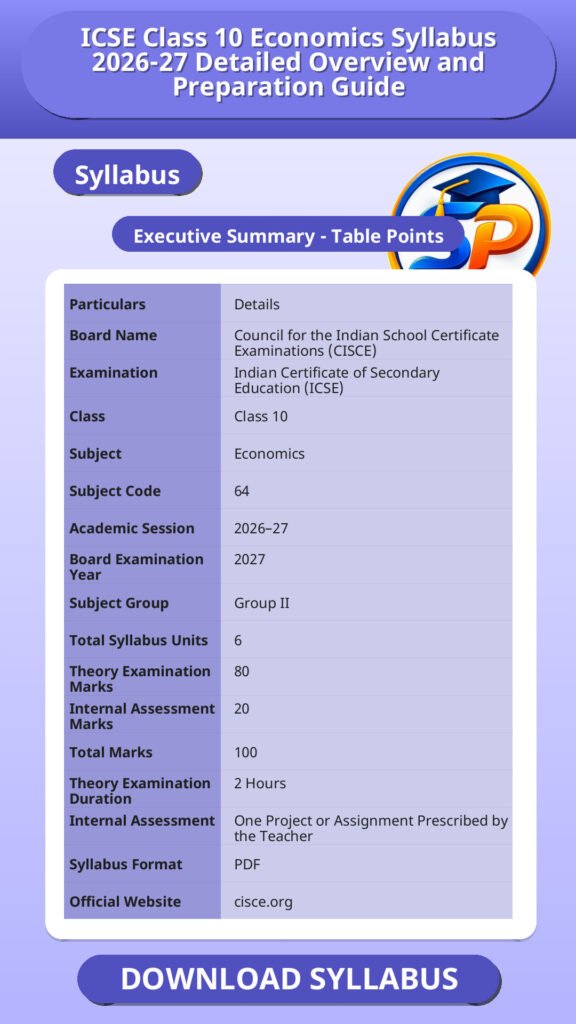
ICSE Class 10 Economics Syllabus 2026-27 covers six major units for students preparing for the ICSE 2027 board examination. The syllabus includes The Productive Mechanism, Theory of Demand and Supply, Market, Banking in India, Inflation and Consumer Awareness. The Economics examination carries 80 marks in theory and 20 marks in internal assessment, with a two-hour written paper.
यह पाठ्यक्रम 2027 बोर्ड परीक्षा के लिए छह मुख्य इकाइयों पर आधारित है, जिसमें थ्योरी के 80 और आंतरिक मूल्यांकन के 20 अंक होते हैं। परीक्षा दो घंटे की होती है, इसलिए समय प्रबंधन जरूरी है।
Students should prepare the complete chapter-wise syllabus, including important economic concepts, demand and supply curves, banking functions, inflation and consumer rights. The Council for the Indian School Certificate Examinations (CISCE) publishes its official syllabuses through cisce.org. Candidates should select the syllabus labelled Examination Year 2027.
सभी विषयों को पूरी तरह से समझना आवश्यक है, खासकर मांग-आपूर्ति, बैंकिंग और उपभोक्ता अधिकार। आधिकारिक वेबसाइट से नवीनतम 2027 सिलेबस डाउनलोड करें।
Source
Vacancy/Update Name: ICSE Class 10 Economics Syllabus 2026-27 Overview
ICSE Class 10 Economics Syllabus 2026-27 Overview
| Particulars | Details |
|---|---|
| Board Name | Council for the Indian School Certificate Examinations (CISCE) |
| Examination | Indian Certificate of Secondary Education (ICSE) |
| Class | Class 10 |
| Subject | Economics |
| Subject Code | 64 |
| Academic Session | 2026–27 |
| Board Examination Year | 2027 |
| Subject Group | Group II |
| Total Syllabus Units | 6 |
| Theory Examination Marks | 80 |
| Internal Assessment Marks | 20 |
| Total Marks | 100 |
| Theory Examination Duration | 2 Hours |
| Internal Assessment | One Project or Assignment Prescribed by the Teacher |
| Syllabus Format | |
| Official Website | cisce.org |
यह सारांश परीक्षा की मुख्य जानकारियों को एक साथ दिखाता है, जैसे बोर्ड, विषय कोड, कुल अंक और आंतरिक मूल्यांकन। इससे तैयारी के लिए स्पष्ट दिशा मिलती है।
ICSE Class 10 Economics Syllabus 2026-27 PDF Download
CISCE provides subject-wise syllabus documents through its official website. Students should choose Economics (64) for the ICSE Examination Year 2027.
| Description | Official Link |
|---|---|
| ICSE Class 10 Economics Syllabus 2027 | Find Examination Year 2027 Syllabus |
| Economics Syllabus Reference for Examination Year 2028 | View 2028 Economics PDF |
सिलेबस पीडीएफ आधिकारिक वेबसाइट से डाउनलोड करें और सुनिश्चित करें कि आपने 2027 परीक्षा वर्ष का ही चुना है, ताकि अपडेटेड सामग्री मिल सके।
ICSE Class 10 Economics Syllabus 2026-27 Chapter-Wise
The Economics syllabus for the ICSE Class 10 examination covers six major units. Each unit contains several concepts and subtopics that students should prepare.
| Unit | Chapter Name | Major Topics |
|---|---|---|
| 1 | The Productive Mechanism | Land, Labour, Capital, Entrepreneur and Factors of Production |
| 2 | Theory of Demand and Supply | Demand, Supply, Curves, Laws, Elasticity and Determinants |
| 3 | Market | Perfect Competition, Monopoly, Monopolistic Competition and Oligopoly |
| 4 | Banking in India | Money, Commercial Banks, Central Bank, Monetary Policy and Public Finance |
| 5 | Inflation | Stages, Types, Causes and Effects of Inflation |
| 6 | Consumer Awareness | Consumer Rights, Consumer Protection, RTI, PDS and Quality Certification |
छह यूनिट्स में विभाजित यह सिलेबस पूरे आर्थिक विषय को कवर करता है, जिससे विद्यार्थी सभी आवश्यक विषयों को क्रमवार पढ़कर अच्छी तैयारी कर सकते हैं।
Unit 1: The Productive Mechanism
This unit introduces the four major factors of production and explains their contribution to economic activities.
Important Topics
- Meaning and characteristics of land as a factor of production.
- Productivity of land and factors affecting land productivity.
- Meaning and characteristics of labour.
- Division of labour, its types and advantages.
- Efficiency of labour and reasons for low labour efficiency in India.
- Meaning and characteristics of capital.
- Physical and financial capital with examples.
- Capital formation, its process and importance.
- Meaning of entrepreneur.
- Functions of an entrepreneur and contribution to economic development.
Students should understand the differences among land, labour, capital and entrepreneurship and explain how each contributes to production.
यह यूनिट उत्पादन के चार मुख्य तत्वों पर केंद्रित है और समझाती है कि कैसे ये आर्थिक गतिविधियों में योगदान देते हैं, जो बुनियादी आर्थिक समझ के लिए जरूरी है।
Unit 2: Theory of Demand and Supply
This unit examines how consumer demand and market supply are related to price and other economic factors.
Important Topics
- Meaning and concept of demand and supply.
- Types of demand.
- Law of demand and law of supply.
- Individual and market demand schedules.
- Individual and market supply schedules.
- Demand and supply curves.
- Movement along demand and supply curves.
- Shift in demand and supply curves.
- Determinants of demand and supply.
- Exceptions to the law of demand.
- Meaning and types of elasticity of demand.
- Meaning and types of elasticity of supply.
- Percentage method of measuring price elasticity.
- Factors affecting elasticity of demand and supply.
Students should practise drawing and interpreting demand and supply curves and clearly distinguish a movement along a curve from a shift of the entire curve.
Important: The accessible CISCE Economics syllabus reference specifies that numerical problems on elasticity are not for testing. Students should follow the corresponding instructions in their Examination Year 2027 document when preparing.
मांग और आपूर्ति की अवधारणाओं को समझना और उनके ग्राफ बनाना आवश्यक है, लेकिन इस वर्ष इलास्टिसिटी के गणितीय प्रश्न नहीं पूछे जाएंगे, इसलिए आधिकारिक निर्देशों का पालन करें।
Unit 3: Market
The Market unit covers the meaning of a market and the different types of market structures.
| Market Type | Main Concept |
|---|---|
| Perfect Competition | A Market with Many Buyers and Sellers |
| Monopoly | A Market with a Single Seller |
| Monopolistic Competition | Competition Among Sellers Offering Differentiated Products |
| Oligopoly | A Market Dominated by a Small Number of Sellers |
बाजार के प्रकार समझने से यह पता चलता है कि किस तरह प्रतिस्पर्धा या एकाधिकार बाजार को प्रभावित करते हैं, जो व्यावहारिक आर्थिक ज्ञान के लिए जरूरी है।
Unit 4: Banking in India
Banking in India is a broad unit that includes money, commercial banks, central banking, monetary policy and public finance.
Money
- Barter system and its limitations.
- Evolution and legal meaning of money.
- Money as a medium of exchange.
- Money as a measure of value.
- Money as a store of value.
- Money as a standard of deferred payment.
Commercial Banks
- Meaning and functions of commercial banks.
- Types of bank deposits.
- Types of loans and methods of advancing loans.
- Basic process of credit creation.
- Primary and derivative deposits.
Central Bank and Monetary Policy
- Meaning and functions of the central bank.
- Issue of currency notes.
- Banker’s bank and lender of last resort.
- Banker, agent and adviser to the government.
- Custodian of foreign exchange.
- Qualitative credit control methods, including moral suasion, margin requirements and credit rationing.
- Quantitative credit control methods, including Bank Rate, Open Market Operations, Cash Reserve Ratio and Statutory Liquidity Ratio.
- Basic understanding of demonetisation.
Public Finance
- Meaning of public finance.
- Sources of public revenue.
- Direct and indirect taxes and their differences.
- Meaning and objectives of Goods and Services Tax (GST).
- Progressive, proportional, regressive and degressive taxes.
- Non-tax revenue with examples.
- Public expenditure and its classification.
- Revenue expenditure and capital expenditure.
- Reasons for increasing public expenditure.
- Meaning and types of public debt.
Students should particularly practise comparison questions covering commercial banks and central banks, qualitative and quantitative credit controls, and direct and indirect taxation.
इस यूनिट में बैंकिंग, मुद्रा प्रणाली, मौद्रिक नीति और सार्वजनिक वित्त जैसे विषय शामिल हैं, जिनमें बैंक के प्रकार, कर्ज प्रक्रिया और कर प्रणाली पर ध्यान देना जरूरी है।
Unit 5: Inflation
This unit focuses on the meaning, categories, causes and economic effects of inflation.
Important Topics
- Meaning of inflation.
- Creeping inflation.
- Walking inflation.
- Running inflation.
- Hyperinflation.
- Demand-pull inflation.
- Cost-push inflation.
- Causes of demand-pull and cost-push inflation.
- Differences between the two main types of inflation.
- Negative effects of inflation on production.
- Effects of inflation on fixed-income earners and business-income groups.
Students should understand the differences among inflation types and explain their effects using simple examples.
महंगाई के विभिन्न प्रकार और उनके कारण समझना जरूरी है ताकि इसके आर्थिक प्रभावों को सही ढंग से समझा जा सके, जैसे उत्पादन और आय पर असर।
Unit 6: Consumer Awareness
The final unit deals with consumer exploitation, rights, duties and protection mechanisms.
Important Topics
- Meaning of consumer exploitation.
- Forms and reasons for consumer exploitation.
- Meaning and importance of consumer awareness.
- Consumer rights and consumer duties.
- Consumer Protection Act, 2019.
- Right to Information (RTI).
- Food adulteration and its harmful effects.
- Public Distribution System (PDS).
- Bureau of Indian Standards (BIS).
- AGMARK certification.
- ECOMARK certification.
Students should be able to explain how consumer rights, consumer protection laws and standardisation marks help protect buyers.
उपभोक्ता अधिकार और संरक्षण से संबंधित जानकारी से विद्यार्थी समझ सकते हैं कि उपभोक्ता को किस तरह धोखाधड़ी से बचाया जाता है और गुणवत्ता मानकों का महत्व क्या है।
ICSE Class 10 Economics Exam Pattern 2027
The Economics examination combines a written theory paper with an internal project or assignment.
| Component | Marks | Duration or Method |
|---|---|---|
| Theory Examination | 80 | 2 Hours |
| Internal Assessment | 20 | Economics Project or Assignment |
| Total | 100 | Theory Plus Internal Assessment |
The official subject syllabus specifies the overall assessment division. Students should refer to the specimen question paper for the question format, section-wise choices and applicable marking instructions.
परीक्षा में 80 अंक थ्योरी के लिए और 20 अंक आंतरिक मूल्यांकन के लिए होते हैं, इसलिए दोनों हिस्सों की तैयारी पर ध्यान देना जरूरी है।
ICSE Class 10 Economics Chapter-Wise Marks Distribution
The syllabus establishes the six required units but does not provide a confirmed fixed marks allocation for each individual chapter.
Students should not assume that every unit carries equal marks or rely on unofficial chapter-wise weightage tables as guaranteed examination allocations.
Prepare all six units and use the official specimen papers and previous examination papers to understand the expected question format.
हर इकाई के लिए निश्चित अंक वितरण नहीं दिया गया है, इसलिए सभी यूनिट्स की पूरी तैयारी करें और पिछले पेपरों से प्रश्नों के प्रकार को समझें।
ICSE Class 10 Economics Internal Assessment 2026-27
Students must complete at least one Economics project or assignment prescribed by their teacher.
The internal assessment carries 20 marks. The subject teacher and an external examiner assess the project independently.
| Evaluation Component | Marks |
|---|---|
| Subject Teacher or Internal Examiner | 10 |
| External Examiner | 10 |
| Total | 20 |
आंतरिक मूल्यांकन में प्रोजेक्ट का महत्व है, जिसे शिक्षक और बाहरी परीक्षक दोनों अलग-अलग मूल्यांकन करते हैं, इसलिए अच्छे से प्रोजेक्ट पूरा करें।
ICSE Class 10 Economics Project Topics
The published syllabus provides project and assignment examples related to factors of production, taxation and GST.
Project 1: Factors of Production
Visit a local industrial unit and study how land, labour, capital and entrepreneurship are combined in the production process.
Project 2: Survey on Taxes
Conduct a survey of 15 people in the neighbourhood to study the types of taxes they pay. Analyse which type of tax respondents find easier to pay and explain the conclusion.
Project 3: Impact of GST
Visit a nearby store and select five commonly purchased products. Examine the impact of GST on their prices or demand and discuss the benefits or implications for producers, consumers and the government.
The final project topic, submission format and assessment requirements should be confirmed with the school’s Economics teacher.
प्रोजेक्ट टॉपिक्स उत्पादन के तत्व, कर और GST जैसे प्रासंगिक विषयों पर आधारित हैं, जो व्यावहारिक अनुभव और समझ बढ़ाने में मदद करते हैं।
How to Download ICSE Class 10 Economics Syllabus 2026-27?
- Visit the official CISCE website at cisce.org.
- Open the syllabus or regulations and syllabuses section.
- Select the ICSE examination.
- Choose the syllabus corresponding to Examination Year 2027.
- Find Economics under the Group II subjects.
- Open the Economics (64) syllabus document.
- Verify that its cover or page headings refer to Examination Year 2027.
- Download and save the PDF for examination preparation.
आधिकारिक वेबसाइट से सही वर्ष और विषय का सिलेबस डाउनलोड करना सुनिश्चित करें ताकि परीक्षा की तैयारी नवीनतम नियमों के अनुसार हो।
ICSE Class 10 Economics 2026-27 Preparation Tips
- Begin preparation with the six units listed in the syllabus.
- Learn important definitions and distinguish closely related economic concepts.
- Practise demand and supply schedules and curves.
- Prepare comparison tables for different market structures.
- Understand banking functions, GST and monetary policy terminology.
- Revise inflation types, their causes and effects.
- Learn consumer rights, duties and important consumer protection measures.
- Complete the Economics project according to the teacher’s instructions.
- Use official specimen and past examination papers for revision.
- Revise the complete syllabus instead of relying on unverified chapter weightage.
सभी यूनिट्स को क्रम से पढ़ें, महत्वपूर्ण अवधारणाओं को स्पष्ट करें, और आधिकारिक मॉडल पेपर से अभ्यास करें। प्रोजेक्ट को भी समय पर पूरा करना जरूरी है।
Difference Between ICSE Economics and Economic Applications
ICSE Economics and Economic Applications are separate subjects with different subject codes and syllabus requirements.
| Particulars | Economics | Economic Applications |
|---|---|---|
| Subject Code | 64 | 87 |
| Subject Group | Group II | Group III |
| Curriculum | Economics Concepts and Economic Systems | Applied Economic Concepts |
| Syllabus | Separate Official Document | Separate Official Document |
Economics और Economic Applications विषय अलग हैं, इसलिए छात्रों को सही विषय कोड और सिलेबस के अनुसार ही तैयारी करनी चाहिए।
ICSE Class 10 Economics Syllabus 2026 – Important Links
| Description | Official Link |
|---|---|
| ICSE Class 10 Economics Syllabus 2027 | Find Official 2027 Syllabus |
| CISCE Official Website | Visit CISCE |
| Economics 2028 Syllabus Reference (Not the 2027 Edition) | View 2028 Reference PDF |
सरकारी वेबसाइट से हमेशा नवीनतम और आधिकारिक सिलेबस और संदर्भ सामग्री देखें ताकि परीक्षा की तैयारी विश्वसनीय हो।
ICSE Class 10 Economics Syllabus 2026-27 – FAQs
Q1. Is the ICSE Class 10 Economics Syllabus 2026-27 available?
Yes. The syllabus for the ICSE 2027 examination covers six major Economics units. Students should access the official Examination Year 2027 document through CISCE.
Q2. How many chapters are in ICSE Class 10 Economics?
The syllabus is organised into six units: The Productive Mechanism, Theory of Demand and Supply, Market, Banking in India, Inflation and Consumer Awareness.
Q3. What is the ICSE Class 10 Economics syllabus PDF download website?
The official syllabus website is cisce.org. Students should select Economics (64) for Examination Year 2027.
Q4. What is the ICSE Economics subject code?
The subject code for Economics is 64.
Q5. How many marks are there in ICSE Class 10 Economics?
Economics carries 100 marks in total, including 80 marks for theory and 20 marks for internal assessment.
प्रमुख सवालों के जवाब सिलेबस की मूल बातें स्पष्ट करते हैं, जैसे विषय कोड, कुल अंक, और आधिकारिक डाउनलोड लिंक।
Disclaimer
Yeh job post sirf informational purpose ke liye banayi gayi hai taaki aapko recruitment ki details simple aur samajhne layak format me mil sake.
Time ke saath details me changes ho sakte hain (jaise dates, vacancies, eligibility, etc.). Isliye apply karne se pehle official notification ko zarur verify karein.
Hum kisi bhi typing error, outdated information ya misunderstanding ke liye zimmedar nahi honge.