
📘 Job Overview
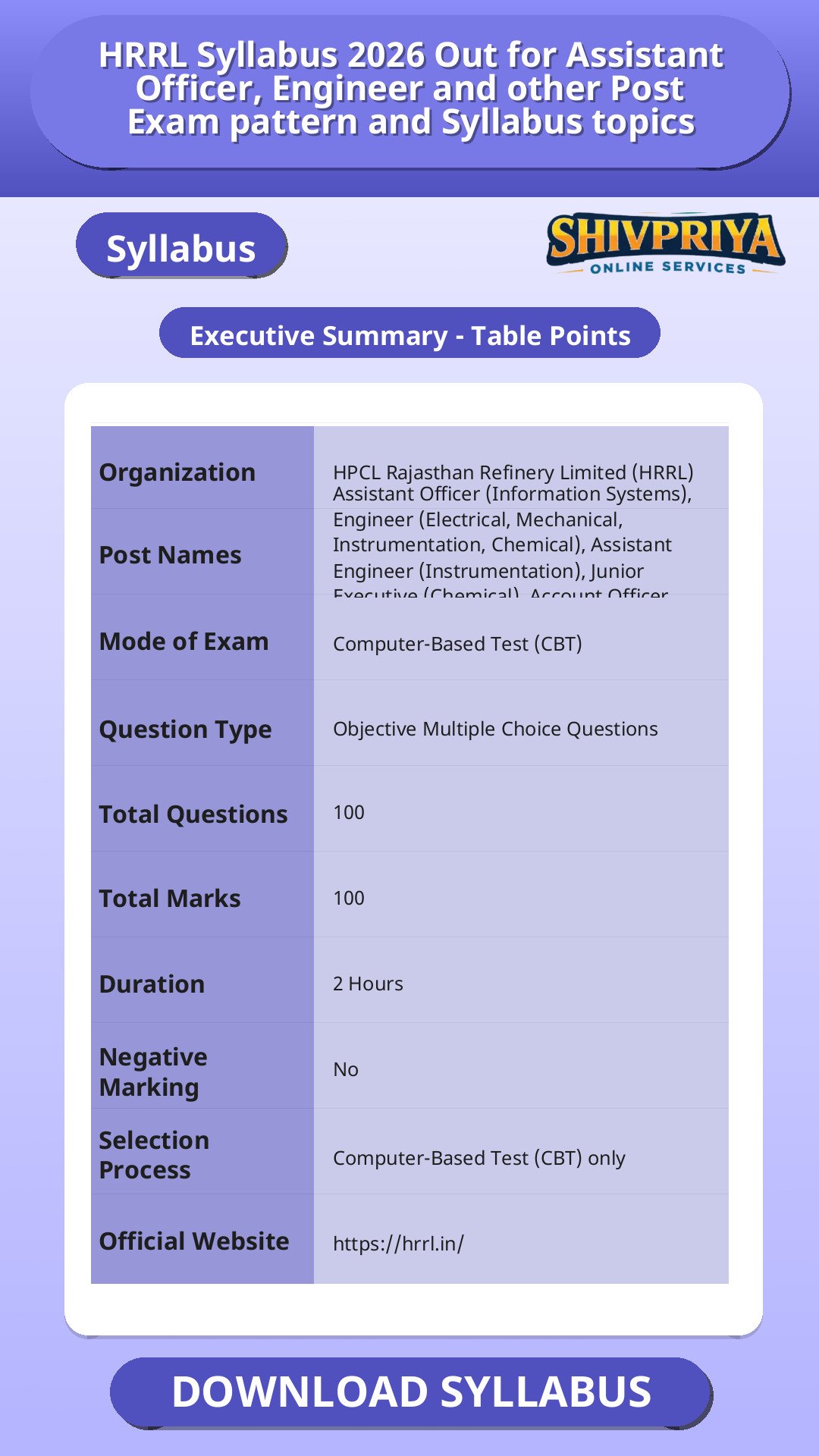
| Organization | HPCL Rajasthan Refinery Limited (HRRL) |
|---|---|
| Post Names | Assistant Officer (Information Systems), Engineer (Electrical, Mechanical, Instrumentation, Chemical), Assistant Engineer (Instrumentation), Junior Executive (Chemical), Account Officer, Assistant Accounts Officer |
| Mode of Exam | Computer-Based Test (CBT) |
| Question Type | Objective Multiple Choice Questions |
| Total Questions | 100 |
| Total Marks | 100 |
| Duration | 2 Hours |
| Negative Marking | No |
| Selection Process | Computer-Based Test (CBT) only |
| Official Website | https://hrrl.in/ |
📘 Syllabus Summary
Syllabus Summary
HRRL Syllabus 2026 applies to the Computer-Based Test for nine different posts in HPCL Rajasthan Refinery Limited. The exam pattern consists of 100 multiple-choice questions to be answered in 2 hours, divided into General Aptitude (30 marks) and Technical/Professional Knowledge (70 marks) sections. The selection process is based solely on the CBT score without any negative marking, ensuring fair evaluation. The syllabus includes a common General Aptitude section assessing reasoning, quantitative aptitude, and English language skills, along with post-specific technical subjects ranging from Information Systems to Chemical Engineering and Accountancy. Candidates can download official syllabus PDFs from the HRRL website for detailed preparation.📝 Exam Pattern
Exam Pattern
HRRL CBT 2026 is conducted in a single stage with two main sections: General Aptitude and Technical/Professional Knowledge. The total duration is 2 hours. Each correct answer awards 1 mark, and there is no negative marking for wrong answers.| Section | Questions | Marks | Duration |
|---|---|---|---|
| General Aptitude | 30 | 30 | 2 Hours (Total) |
| Technical/Professional Knowledge | 70 | 70 |
🎯 Selection Process
Selection Process
HRRL follows a straightforward selection process based on the Computer-Based Test (CBT) scores. Candidates who qualify by scoring well in both the General Aptitude and Technical/Professional Knowledge sections are shortlisted for final appointment. There are no additional stages like interviews or skill tests mentioned for the 2026 recruitment cycle.📝 Important Topics For The Exam
Important Topics For The Exam
- General Aptitude topics such as Logical Reasoning, Data Interpretation, Quantitative Aptitude, and English Language are common to all posts and should be prioritized.
- Technical topics vary by post and include specialized areas like Digital Logic and Computer Networks for Information Systems, Electrical Circuits and Power Systems for Electrical Engineering, Instrumentation and Automation topics, Chemical Engineering process calculations, and Accounting principles for finance posts.
- Focus on high-weightage subjects like Process Safety for Chemical posts, Operating Systems for IT posts, and Taxation for Accounts posts.
- Revision should emphasize understanding key concepts in your applied post’s technical domain alongside practicing aptitude and reasoning questions.
📑 Preparation Strategy
Preparation Strategy
- Start by thoroughly understanding the syllabus and exam pattern for your respective post.
- Allocate more time to the Technical/Professional Knowledge section as it carries 70% of the marks.
- Practice General Aptitude regularly to build speed and accuracy, especially in reasoning and quantitative aptitude.
- Use official syllabus PDFs and recommended books for in-depth study of technical subjects.
- Take mock tests to simulate exam conditions, identify weak areas, and improve time management skills.
- Revise important formulas, definitions, and concepts periodically to retain information effectively.
- Maintain a balanced study plan with short breaks to avoid burnout and stay motivated.
📑 Recommended Books
Recommended Books
| Subject | Recommended Book | Author / Publication |
|---|---|---|
| General Aptitude | Quantitative Aptitude for Competitive Exams | R.S. Aggarwal |
| Logical Reasoning & Data Interpretation | A Modern Approach to Verbal & Non-Verbal Reasoning | R.S. Aggarwal |
| English Language | Objective General English | S.P. Bakshi |
| Information Systems | Computer Science: An Overview | J. Glenn Brookshear |
| Electrical Engineering | Electrical Machines | P.S. Bimbhra |
| Instrumentation Engineering | Process Control Instrumentation Technology | C.D. Johnson |
| Chemical Engineering | Introduction to Chemical Engineering Thermodynamics | J.M. Smith |
| Accountancy | Financial Accounting | Weygandt, Kimmel & Kieso |
⭐ Important Links
Important Links
| Link Description | Link |
|---|---|
| HRRL Official Website | https://hrrl.in/ |
| Assistant Officer - Information Systems Syllabus PDF 2026 | Download PDF |
| Engineer - Electrical Syllabus PDF 2026 | Download PDF |
| Engineer - Instrumentation Syllabus PDF 2026 | Download PDF |
| Junior Executive - Chemical Syllabus PDF 2026 | Download PDF |
| Account Officer Syllabus PDF 2026 | Download PDF |
| Assistant Accounts Officer Syllabus PDF 2026 | Download PDF |
| Engineer - Mechanical Syllabus PDF 2026 | Download PDF |
| Assistant Engineer - Instrumentation Syllabus PDF 2026 | Download PDF |
| Engineer - Chemical Syllabus PDF 2026 | Download PDF |
📘 General Aptitude Syllabus 30 Marks Common To All Posts
General Aptitude Syllabus (30 Marks) - Common to All Posts
इस सेक्शन में सभी पदों के लिए समान सामान्य योग्यता शामिल है जो reasoning, quantitative aptitude, और English language कौशल का आकलन करता है। General Aptitude section is designed to test candidates’ reasoning ability, numerical aptitude, and English proficiency at the graduate level (HSC level for Junior Executive - Chemical). It has four broad parts:- Intellectual Potential Test: Cognitive abilities like distance, syllogism, logical operations, verbal comprehension, perceptual reasoning, working memory, and fluid reasoning.
- Logical Reasoning & Data Interpretation: Includes puzzles, seating arrangements, coding-decoding, analogies, binary logic, games, order ranking, and data interpretation from charts and tables.
- Quantitative Aptitude: Standard math topics such as number systems, LCM/HCF, ratios, percentages, profit & loss, simple & compound interest, mensuration, time & work, algebraic identities, and data interpretation.
- English Language: Grammar, vocabulary, sentence completion, para jumbles, reading comprehension, synonyms, antonyms, idioms, and proverbs.
📘 Technical Professional Knowledge Syllabus 70 Marks Post Wise Breakdown
Technical/Professional Knowledge Syllabus (70 Marks) - Post-Wise Breakdown
📑 Assistant Officer Information Systems S G E1
Assistant Officer - Information Systems (S/G E1)
- Digital Logic: Boolean algebra, combinational & sequential circuits, minimization, number representation, computer arithmetic.
- Computer Organization & Architecture: machine instructions, addressing modes, ALU, pipelining, memory hierarchy, I/O interface.
- Programming and Data Structures: basic Java programming concepts.
- Algorithms: searching, sorting, hashing, complexity, graph algorithms, MST, shortest paths.
- Theory of Computation: regular expressions, automata theory, Turing machines, undecidability.
- Operating Systems: processes, threads, IPC, deadlock, scheduling, memory management, file systems, Windows/Linux basics.
- Databases: ER-model, relational algebra, SQL, normal forms, indexing, transactions, concurrency control.
- Computer Networks: OSI/TCP-IP layers, switching, routing, IP addressing, ARP, DHCP, ICMP, TCP/UDP, DNS, SMTP, HTTP, FTP, Email.
📑 Engineer Electrical S G E2
Engineer - Electrical (S/G E2)
- Electric Circuits: network theorems, transient & steady-state analysis, three-phase circuits, power factor.
- Electromagnetic Fields: Coulomb’s law, Gauss’s law, capacitance, Ampere’s & Faraday’s laws, inductance, magnetic circuits.
- Electrical Machines: transformers, DC, induction, synchronous machines, losses, efficiency.
- Power Systems: generation, transmission, distribution, load flow, fault analysis, protection, stability.
- Electrical & Electronic Measurements: bridges, instrument transformers, digital meters, oscilloscopes.
- Power Electronics: thyristors, MOSFET, IGBT, converters, rectifiers, PWM.
📑 Engineer Instrumentation S G E2 Assistant Engineer Instrumentation S G E1
Engineer - Instrumentation (S/G E2) & Assistant Engineer - Instrumentation (S/G E1)
- Electrical & Electronics Measurement, Analog and Digital Electronics.
- Transducers, sensors, actuators, industrial automation.
- Automatic Control Systems, Feedback Control.
- Process Loop Components, Hazardous Area Classification.
- Microprocessors, Microcontrollers.
- Power Electronics, Drives.
- Industrial Automation, PLC, SCADA, DCS.
- Analytical Instrumentation, Instrumentation System Design.
- Optimization, Process Instrumentation and Control.
- Programming Engineering and Project Management (Engineer only).
- Industrial Internet of Things (IIoT), Industry 4.0.
- Soft Computing, AI, Machine Learning for Process Control.
📑 Junior Executive Chemical S G E0
Junior Executive - Chemical (S/G E0)
- Hydrocarbons: alkanes, alkenes, alkynes, aromatics, isomerism, benzene.
- Flammability, explosivity, combustion.
- Polymers: types, reactions, properties.
- Heat Transfer Equipment: heat exchangers, evaporators, fired heaters.
- Process Equipment Operation: pumps, compressors, distillation towers, reactors.
- Process Instrumentation and Control Systems.
- Process Safety: PSM, JSA, HAZOP, hazard identification, risk assessment.
- Firefighting Equipment: fire pumps, gas detectors, extinguishers, foam systems, hoses, ladders.
- Utility Systems: air, water, steam, nitrogen.
- Chemical Thermodynamics, Fluid Mechanics, Heat & Mass Transfer.
- Unit Conversion & Stoichiometry.
📑 Engineer Mechanical S G E2
Engineer - Mechanical (S/G E2)
- Engineering Mechanics, Mechanics of Materials.
- Theory of Machines, Vibrations.
- Machine Design.
- Fluid Mechanics, Heat Transfer.
- Thermodynamics and Industrial Applications.
- Engineering Materials.
- Casting, Forming, Joining Processes.
- Machining, Metrology, Inspection.
- Computer Integrated Manufacturing, Production Planning, Inventory Control.
- Operations Research.
- Power Plant Engineering, Renewable Energy.
- Manufacturing, Industrial, Maintenance Engineering.
- Mechatronics, Robotics.
📑 Engineer Chemical Process S G E2
Engineer - Chemical (Process) (S/G E2)
- Process Calculations, Thermodynamics.
- Fluid Mechanics, Mechanical Operations.
- Heat Transfer including Fired Heaters and Furnaces.
- Mass Transfer: distillation, absorption, extraction, drying.
- Chemical Reaction Engineering.
- Instrumentation and Process Control (DCS, PLC, PID tuning).
- Plant Design and Economics.
- Chemical Technology: petroleum refining, petrochemicals, polymers.
- Net Zero Concepts: decarbonization, CCUS, renewable energy.
- Process Safety: PSM, hazard identification, emergency response.
- Petrochemicals Process: cracking, olefins, aromatics (BTX) production.
📑 Account Officer S G E2
Account Officer (S/G E2)
- CA Foundation: Accounting principles, business laws, math, logical reasoning, economics.
- CA Inter: Accounting, laws, cost accounting, taxation (Income Tax, GST), auditing, financial management.
- CA Final: Financial reporting, strategic financial management, advanced auditing, corporate laws, cost management, risk management, taxation.
📑 Assistant Accounts Officer S G E1
Assistant Accounts Officer (S/G E1)
- Financial Accounting: accounting standards, depreciation, inventories, share capital, company final accounts.
- Cost Accounting: job costing, process costing, budgeting, variance analysis.
- Taxation: basic income tax, computations, GST.
- Auditing: company audits, divisible profits, tax audit.
- Company Law: company formation, operation, dissolution.
📑 Faqs
FAQs
- Q1. When was the HRRL Syllabus 2026 released?
- The HRRL Syllabus 2026 was released on 29 June 2026 on the official portal, hrrl.in/
- Q2. How can I check HRRL Syllabus 2026?
- You can check your HRRL Syllabus 2026 by visiting hrrl.in/, navigating to Examinations → Syllabus section, selecting the relevant syllabus link, and entering your roll or registration number.
- Q3. What is the exam pattern for HRRL CBT 2026?
- The HRRL CBT 2026 is a 2-hour, 100-mark exam with 100 objective multiple-choice questions. Each correct answer earns 1 mark, and there is no negative marking.
- Q4. How many sections are there in the HRRL syllabus?
- There are two parts: Part 1 is General Aptitude (30 marks) common to all posts, and Part 2 is Technical/Professional Knowledge (70 marks) which varies by post.
- Q5. Is there negative marking in the HRRL exam?
- No, HRRL clearly states there is no negative marking for wrong answers in the CBT.
📑 People Also Ask
People Also Ask
- What is the duration of the HRRL Computer-Based Test?
- Which subjects are covered under the General Aptitude section in HRRL exams?
- How can I download the HRRL syllabus PDF for specific posts?
- Are there any interviews after the HRRL CBT for recruitment?
- What is the marking scheme of the HRRL CBT exam?
⚠️ Disclaimer
Disclaimer
Yeh job post sirf informational purpose ke liye banayi gayi hai taaki aapko recruitment ki details simple aur samajhne layak format me mil sake.
Time ke saath details me changes ho sakte hain (jaise dates, vacancies, eligibility, etc.). Isliye apply karne se pehle official notification ko zarur verify karein.
Hum kisi bhi typing error, outdated information ya misunderstanding ke liye zimmedar nahi honge.
🔗 Related Jobs
- Ratnagiri District Court Contractual Employee Recruitment 2026 – Apply Offline
- IIT Roorkee Junior Research Fellow Recruitment 2026 – Apply Now
- IIT BHU Junior Research Assistant Recruitment 2026 – Apply Now for 1 Post
- Comprehensive Guide to BFUHS BSc Paramedical & Nursing Results 2026
- BEML Non Executive Recruitment 2026: Apply Online for 10 Tenure Posts
- Complete Guide to NEHU History 2nd Semester Result 2026 Download and Details

