
HPSC Manager Syllabus 2026 – Check Subject Knowledge Test Exam Pattern
Loading contents...
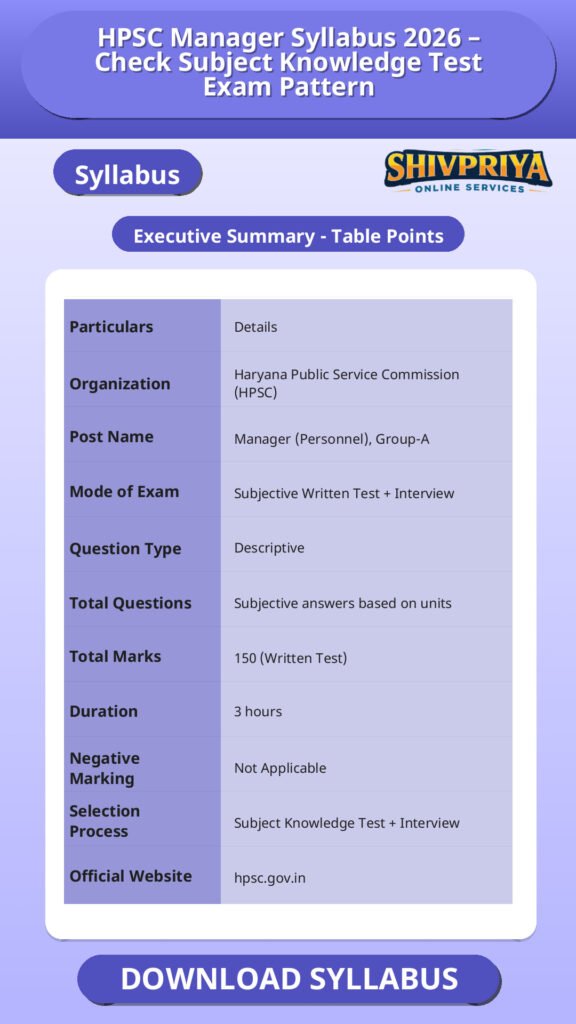
Syllabus Summary
HPSC Manager (Personnel) exam 2026 follows a subjective exam pattern with a written Subject Knowledge Test of 150 marks and an interview stage. The selection process includes qualifying the written test with a minimum of 35% marks to become eligible for the interview. The syllabus covers ten major units focused on management principles, organizational behavior, human resource management, financial and strategic management, marketing, statistics, international business, and entrepreneurship. Candidates should regularly visit the official website hpsc.gov.in for latest updates and notifications.
| Particulars | Details |
|---|---|
| Organization | Haryana Public Service Commission (HPSC) |
| Post Name | Manager (Personnel), Group-A |
| Mode of Exam | Subjective Written Test + Interview |
| Question Type | Descriptive |
| Total Questions | Subjective answers based on units |
| Total Marks | 150 (Written Test) |
| Duration | 3 hours |
| Negative Marking | Not Applicable |
| Selection Process | Subject Knowledge Test + Interview |
| Official Website | hpsc.gov.in |
Exam Pattern
नीचे HPSC Manager (Personnel) परीक्षा के दोनों चरणों का पैटर्न दिया गया है। यह जानकारी लिखित परीक्षा और इंटरव्यू की प्रकृति और अंक वितरण को स्पष्ट करती है।
Subject Knowledge Test Pattern
| Section | Questions | Marks | Duration |
|---|---|---|---|
| Subject Knowledge Test (Descriptive) | Subjective | 150 | 3 hours |
Interview Pattern
| Stage | Eligible Candidates | Weightage in Final Result |
|---|---|---|
| Interview / Viva-Voce | 3x Posts + Bracketed Candidates (with 35% in Written) | 12.5% |
Selection Process
HPSC Manager (Personnel) पद के लिए चयन दो चरणों पर आधारित है। पहला विषय ज्ञान परीक्षा होती है, जो 150 अंकों की लिखित परीक्षा है। इस परीक्षा में न्यूनतम 35% अंक प्राप्त करने वाले उम्मीदवार ही इंटरव्यू के लिए पात्र माने जाएंगे। इंटरव्यू में कुल पदों की तीन गुना संख्या के उम्मीदवारों को बुलाया जाएगा, जिसमें ब्रैकेटेड उम्मीदवार भी शामिल हो सकते हैं। अंतिम चयन में लिखित परीक्षा का 87.5% और इंटरव्यू का 12.5% वज़न होगा।
Important Topics For The Exam
- Management Concepts, Functions, Communication, Decision Making and Organizational Structure
- Organizational Behaviour and Human Resource Management including Recruitment, Training and Compensation
- Strategic Human Resource Management, Performance Appraisal, Industrial Relations and Green HRM
- Accounting Principles, Financial Statement Analysis, Costing and Financial Management
- Capital Budgeting, Portfolio Management, Mergers, Dividend Theories and International Finance
- Strategic Management, Marketing Management including Product, Pricing, Place and Promotion
- Consumer Behaviour, Brand Management, Supply Chain and Emerging Marketing Trends
- Statistics, Probability, Sampling, Hypothesis Testing and Operations Management
- International Business, Foreign Trade, WTO, IT Applications and Technological Change
- Entrepreneurship Development, Innovations, Business Plan, Micro and Small Scale Industries
Preparation Strategy
- योजना बनाकर पढ़ाई करें और प्रत्येक इकाई के लिए नोट्स तैयार करें जिसमें परिभाषाएँ, मॉडल और डायग्राम शामिल हों। यह 3 घंटे के परीक्षा समय में तेजी से उत्तर लिखने में मदद करेगा।
- एचआर संबंधित अध्यायों (Unit II और III) और वित्त/रणनीति विषयों (Unit IV, V और VI) को समान महत्व दें क्योंकि ये सिलेबस का बड़ा हिस्सा हैं।
- पूर्ण लंबाई के विषयगत उत्तर समय सीमा के भीतर लिखने का अभ्यास करें क्योंकि यह परीक्षा वस्तुनिष्ठ नहीं है।
- अंकगणितीय विषय जैसे अनुपात विश्लेषण, पूंजी बजट, लीवरेज और सांख्यिकी (Unit IV, V और VIII) को अलग से अभ्यास करें क्योंकि इनमें समस्या-समाधान वाले प्रश्न आते हैं।
- विषय ज्ञान परीक्षा और इंटरव्यू दोनों में उपस्थिति आवश्यक है, इसलिए वर्तमान प्रबंधन और एचआर विषयों से जुड़ी खबरों पर भी ध्यान दें।
- अधिकारिक HPSC वेबसाइट पर परीक्षा तिथि, एडमिट कार्ड और सिलेबस अपडेट्स पर नजर रखें।
Recommended Books
| Subject | Recommended Book | Author / Publication |
|---|---|---|
| Management Principles | Principles of Management | R. K. Sharma, Tata McGraw Hill |
| Organizational Behaviour | Organizational Behaviour | Stephen P. Robbins, Pearson |
| Human Resource Management | Human Resource Management | Gary Dessler, Pearson |
| Financial Management | Financial Management Theory & Practice | Eugene F. Brigham, Cengage |
| Strategic Management | Strategic Management Concepts | Fred R. David, Pearson |
| Marketing Management | Marketing Management | Philip Kotler, Pearson |
| Statistics | Statistics for Management | Richard I. Levin & David S. Rubin, Pearson |
| International Business | International Business | Charles W. L. Hill, McGraw Hill |
| Entrepreneurship | Entrepreneurship Development | S. S. Khanka, S. Chand |
Important Links
| Link Description | Link |
|---|---|
| Official Announcement & Syllabus PDF | Click Here |
| HPSC Official Website | hpsc.gov.in |
Unit I
Management – Concept, Process, Theories and Approaches, Management Roles and Skills. Functions – Planning, Organizing, Staffing, Coordinating and Controlling. Communication – Types, Process and Barriers. Decision Making – Concept, Process, Techniques and Tools. Organisation Structure and Design – Types, Authority, Responsibility, Centralisation, Decentralisation and Span of Control. Managerial Economics – Concept & Importance. Demand Analysis – Utility Analysis, Indifference Curve, Elasticity & Forecasting. Market Structures – Market Classification & Price Determination. National Income – Concept, Types and Measurement. Inflation – Concept, Types and Measurement. Business Ethics & CSR. Ethical Issues & Dilemma. Corporate Governance. Value Based Organisation.
Unit II
Organisational Behaviour – Significance & Theories. Individual Behaviour – Personality, Perception, Values, Attitude, Learning and Motivation. Group Behaviour – Team Building, Leadership, Group Dynamics. Interpersonal Behaviour & Transactional Analysis. Organizational Culture & Climate. Work Force Diversity & Cross Culture Organisational Behaviour. Emotions and Stress Management. Organisational Justice and Whistle Blowing. Human Resource Management – Concept, Perspectives, Influences and Recent Trends. Human Resource Planning, Recruitment and Selection, Induction, Training and Development. Job Analysis, Job Evaluation and Compensation Management.
Unit III
Strategic Role of Human Resource Management. Competency Mapping & Balanced Scoreboard. Career Planning and Development. Performance Management and Appraisal. Organization Development, Change & OD Interventions. Talent Management & Skill Development. Employee Engagement & Work Life Balance. Industrial Relations: Disputes & Grievance Management, Labour Welfare and Social Security. Trade Union & Collective Bargaining. International Human Resource Management – HR Challenge of International Business. Green HRM.
Unit IV
Accounting Principles and Standards, Preparation of Financial Statements. Financial Statement Analysis – Ratio Analysis, Funds Flow and Cash Flow Analysis, DuPont Analysis. Preparation of Cost Sheet, Marginal Costing, Cost Volume Profit Analysis. Standard Costing & Variance Analysis. Financial Management, Concept & Functions. Capital Structure – Theories, Cost of Capital, Sources and Finance. Budgeting and Budgetary Control, Types and Process, Zero Base Budgeting. Leverages – Operating, Financial and Combined Leverages, EBIT-EPS Analysis, Financial Breakeven Point & Indifference Level.
Unit V
Value & Returns – Time Preference for Money, Valuation of Bonds and Shares, Risk and Returns. Capital Budgeting – Nature of Investment, Evaluation, Comparison of Methods; Risk and Uncertainty Analysis. Dividend – Theories and Determination. Mergers and Acquisition – Corporate Restructuring, Value Creation, Merger Negotiations, Leveraged Buyouts, Takeover. Portfolio Management – CAPM, APT. Derivatives – Options, Option Payoffs, Option Pricing, Forward Contracts & Future Contracts. Working Capital Management – Determinants, Cash, Inventory, Receivables and Payables Management, Factoring. International Financial Management, Foreign Exchange Market.
Unit VI
Strategic Management – Concept, Process, Decision & Types. Strategic Analysis – External Analysis, PEST, Porter’s Approach to Industry Analysis, Internal Analysis – Resource Based Approach, Value Chain Analysis. Strategy Formulation – SWOT Analysis, Corporate Strategy – Growth, Stability, Retrenchment, Integration and Diversification, Business Portfolio Analysis – BCG, GE Business Model, Ansoff’s Product Market Growth Matrix. Strategy Implementation – Challenges of Change, Developing Programs, McKinsey 7s Framework. Marketing – Concept, Orientation, Trends and Tasks, Customer Value and Satisfaction. Market Segmentation, Positioning and Targeting. Product and Pricing Decision – Product Mix, Product Life Cycle, New Product Development, Pricing – Types and Strategies. Place and Promotion Decision – Marketing Channels and Value Networks, VMS, IMC, Advertising and Sales Promotion.
Unit VII
Consumer and Industrial Buying Behaviour: Theories and Models of Consumer Behaviour. Brand Management – Role of Brands, Brand Equity, Equity Models, Developing a Branding Strategy; Brand Name Decisions, Brand Extensions and Loyalty. Logistics and Supply Chain Management, Drivers, Value Creation, Supply Chain Design, Designing and Managing Sales Force, Personal Selling. Service Marketing – Managing Service Quality and Brands, Marketing Strategies of Service Firms. Customer Relationship Marketing – Relationship Building, Strategies, Values and Process. Retail Marketing – Recent Trends in India, Types of Retail Outlets. Emerging Trends in Marketing – Concept of e-Marketing, Direct Marketing, Digital Marketing and Green Marketing. International Marketing – Entry Mode Decisions, Planning Marketing Mix for International Markets.
Unit VIII
Statistics for Management: Concept, Measures of Central Tendency and Dispersion, Probability Distribution – Binomial, Poisson, Normal and Exponential. Data Collection & Questionnaire Design. Sampling – Concept, Process and Techniques. Hypothesis Testing – Procedure; T, Z, F, Chi-square Tests. Correlation and Regression Analysis. Operations Management – Role and Scope. Facility Location and Layout – Site Selection and Analysis, Layout – Design and Process. Enterprise Resource Planning – ERP Modules, ERP Implementation. Scheduling; Loading, Sequencing and Monitoring. Quality Management and Statistical Quality Control, Quality Circles, Total Quality Management – KAIZEN, Benchmarking, Six Sigma; ISO 9000 Series Standards. Operation Research – Transportation, Queuing Decision Theory, PERT / CPM.
Unit IX
International Business – Managing Business in Globalization Era; Theories of International Trade; Balance of Payment. Foreign Direct Investment – Benefits and Costs. Multilateral Regulation of Trade and Investment under WTO. International Trade Procedures and Documentation; EXIM Policies. Role of International Financial Institutions – IMF and World Bank. Information Technology – Use of Computers in Management Applications; MIS, DSS. Artificial Intelligence and Big Data. Data Warehousing, Data Mining and Knowledge Management – Concepts. Managing Technological Change.
Unit X
Entrepreneurship Development – Concept, Types, Theories and Process, Developing Entrepreneurial Competencies. Intrapreneurship – Concept and Process. Women Entrepreneurship and Rural Entrepreneurship. Innovations in Business – Types of Innovations, Creating and Identifying Opportunities, Screening of Business Ideas. Business Plan and Feasibility Analysis – Concept and Process of Technical, Market and Financial Analysis. Micro and Small Scale Industries in India; Role of Government in Promoting SSI. Sickness in Small Industries – Reasons and Rehabilitation. Institutional Finance to Small Industries – Financial Institutions, Commercial Banks, Cooperative Banks, Micro Finance.
FAQs
- Q1. What is the HPSC Manager (Personnel) syllabus 2026?
- The syllabus covers 10 units including Management, Organisational Behaviour, Human Resource Management, Financial Management, Strategic Management, Marketing, Statistics & Operations Management, International Business, and Entrepreneurship, as released by HPSC for Advertisement No. 01/2026.
- Q2. What is the exam pattern for the HPSC Manager (Personnel) post?
- The exam consists of a subjective-type Subject Knowledge Test of 150 marks, to be attempted in English within 3 hours, followed by an interview. The Subject Knowledge Test carries 87.5% weightage and the interview carries 12.5% weightage in the final result.
- Q3. Is there negative marking in the HPSC Manager (Personnel) exam?
- The official announcement does not mention negative marking. Since the paper is subjective (descriptive) and not objective/MCQ-based, negative marking does not apply in the conventional sense.
- Q4. What are the qualifying marks for the HPSC Manager (Personnel) Subject Knowledge Test?
- Candidates must secure a minimum of 35% marks in the Subject Knowledge Test to be considered for the interview stage.
- Q5. How many candidates will be called for interview?
- The number of candidates called for interview will be three times the number of advertised posts, along with bracketed candidates (if any), subject to securing the minimum qualifying marks of 35%.
People Also Ask
- What is the duration of the HPSC Manager (Personnel) written exam?
- The written Subject Knowledge Test is 3 hours long.
- Which subjects carry the highest weightage in the HPSC Manager syllabus?
- Human Resource Management, Financial Management, and Strategic Management units have significant weightage in the syllabus.
- Is the HPSC Manager (Personnel) exam conducted online or offline?
- The exam is conducted in a subjective, offline written format.
- Are candidates required to write the exam in English only?
- Yes, the medium of the exam is English as per the official notification.
- Where can I find the official syllabus and notification for HPSC Manager 2026?
- The official syllabus and notification are available on the HPSC website: hpsc.gov.in.
“`
Related Categories
Disclaimer
Yeh job post sirf informational purpose ke liye banayi gayi hai taaki aapko recruitment ki details simple aur samajhne layak format me mil sake.
Time ke saath details me changes ho sakte hain (jaise dates, vacancies, eligibility, etc.). Isliye apply karne se pehle official notification ko zarur verify karein.
Hum kisi bhi typing error, outdated information ya misunderstanding ke liye zimmedar nahi honge.