
UPSSSC FSL Syllabus and Exam Pattern 2026
Loading contents...
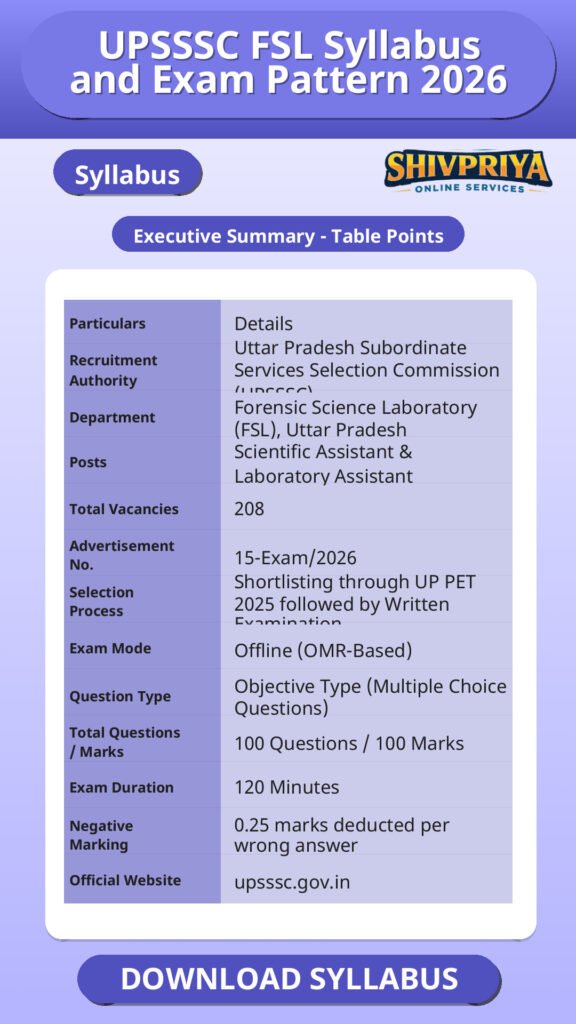
The Uttar Pradesh Subordinate Services Selection Commission (UPSSSC) conducts the written examination for Scientific Assistant and Laboratory Assistant posts under the Forensic Science Laboratory (FSL), Uttar Pradesh. Candidates shortlisted through UP PET 2025 appear for this OMR-based written exam, so understanding the UPSSSC FSL Syllabus 2026 together with the UPSSSC FSL Exam Pattern is essential for structuring preparation. This article covers the exam pattern, marking scheme, subject-wise syllabus, and a preparation strategy based on the available source material.
Source
Vacancy/Update Name: UPSSSC FSL Syllabus and Exam Pattern 2026 – Overview | Advt. No.: 15-Exam/2026
UPSSSC FSL Syllabus and Exam Pattern 2026 – Overview
| Particulars | Details |
|---|---|
| Recruitment Authority | Uttar Pradesh Subordinate Services Selection Commission (UPSSSC) |
| Department | Forensic Science Laboratory (FSL), Uttar Pradesh |
| Posts | Scientific Assistant & Laboratory Assistant |
| Total Vacancies | 208 |
| Advertisement No. | 15-Exam/2026 |
| Selection Process | Shortlisting through UP PET 2025 followed by Written Examination |
| Exam Mode | Offline (OMR-Based) |
| Question Type | Objective Type (Multiple Choice Questions) |
| Total Questions / Marks | 100 Questions / 100 Marks |
| Exam Duration | 120 Minutes |
| Negative Marking | 0.25 marks deducted per wrong answer |
| Official Website | upsssc.gov.in |
इस भर्ती में कुल 208 पद हैं और चयन दो चरणों में होता है: पहले UP PET 2025 के जरिए शॉर्टलिस्टिंग, फिर लिखित परीक्षा। परीक्षा ऑफ़लाइन OMR आधारित होती है जिसमें 100 प्रश्न होते हैं, हर सही उत्तर 1 मार्क देता है और गलत उत्तर पर 0.25 अंक काटे जाते हैं। कुल समय 120 मिनट है।
UPSSSC FSL Selection Process 2026
Based on the available source, the UPSSSC FSL recruitment follows a two-stage process:
- Shortlisting through UP PET 2025: Candidates are shortlisted for the written examination based on their scores in the Uttar Pradesh Preliminary Eligibility Test (PET) 2025.
- Written Examination: Shortlisted candidates appear for the OMR-based objective written exam covering the technical and general sections detailed below.
Further stages, if any (such as document verification or final merit preparation), are not specified in the source used for this article. Candidates should verify the complete selection process against the official UPSSSC notification.
उम्मीदवारों का चयन पहले UP PET 2025 के अंक के आधार पर शॉर्टलिस्टिंग से होता है और उसके बाद OMR आधारित लिखित परीक्षा होती है। आगे के चरण जैसे दस्तावेज़ सत्यापन या अंतिम मेरिट की सूचना आधिकारिक नोटिफिकेशन में देखनी चाहिए।
UPSSSC FSL Exam Pattern 2026
The UPSSSC FSL written examination consists of 100 objective-type questions worth 100 marks, divided into three parts. The technical subjects in Part I and Part II together account for the majority of the paper.
| Part | Subject | Questions | Marks |
|---|---|---|---|
| Part I | Physics | 10 | 10 |
| Chemistry | 10 | 10 | |
| Biology | 10 | 10 | |
| Mathematics | 10 | 10 | |
| Forensic Science | 25 | 25 | |
| Part II | Computer & Information Technology and Recent Technological Developments & Innovations | 15 | 15 |
| Part III | General Information Related to Uttar Pradesh | 20 | 20 |
| Total | 100 | 100 | |
परीक्षा तीन भागों में विभाजित है, जिसमें पहला भाग फिजिक्स, केमिस्ट्री, बायोलॉजी, मैथमैटिक्स और फॉरेंसिक साइंस के लिए है, जो कुल 65 प्रश्न और 65 अंक के हैं। दूसरा भाग कंप्यूटर और नवीनतम तकनीकी विकासों पर 15 प्रश्नों का है और तीसरा भाग उत्तर प्रदेश सामान्य ज्ञान के लिए 20 प्रश्नों का है।
UPSSSC FSL Marking Scheme
- Each correct answer carries 1 mark.
- A deduction of 0.25 marks applies for each incorrect answer.
- The total exam duration is 120 minutes.
- The paper consists entirely of objective-type multiple-choice questions.
- Category-wise qualifying marks / minimum percentage are not specified in the official source; candidates should check the official notification once available.
हर सही उत्तर को 1 अंक मिलेगा और गलत उत्तर पर 0.25 अंक कटेंगे। परीक्षा पूरी तरह MCQ आधारित है और दो घंटे का समय मिलेगा। कट-ऑफ या न्यूनतम अंक आधिकारिक नोटिफिकेशन में देखना जरूरी है।
UPSSSC FSL Syllabus 2026
The UPSSSC FSL syllabus covers five subjects under Part I – Physics, Chemistry, Biology, Mathematics, and Forensic Science – followed by Computer & Information Technology in Part II and Uttar Pradesh General Knowledge in Part III. The topic-wise breakdown below is based on the available syllabus reference; candidates should cross-check it against the official syllabus PDF once released.
1. Physics Syllabus
Physics carries 10 marks in Part I.
- Mechanics: units and dimensions, scalars and vectors, motion in one and two dimensions, Newton’s laws of motion, work, energy and power, circular motion, gravitation, momentum and collisions, rotational motion, simple harmonic motion, elasticity and viscosity
- Heat and Thermodynamics: temperature and heat, thermal expansion, laws of thermodynamics, heat transfer, kinetic theory of gases, specific heat and latent heat
- Waves and Sound: wave motion, properties of waves, sound waves, Doppler effect, resonance, ultrasonics and applications
- Optics: reflection and refraction, mirrors and lenses, optical instruments, interference, diffraction, polarization, laser basics, fibre optics
- Electricity and Magnetism: Coulomb’s law, electric field and potential, capacitance, current electricity, Ohm’s law, Kirchhoff’s laws, magnetic field, electromagnetic induction, alternating current and transformers
- Electronics: semiconductors, diodes and transistors, rectifiers, amplifiers, digital electronics, logic gates, binary system, basics of communication systems
- Modern Physics: atomic structure, Bohr’s model, photoelectric effect, X-rays, radioactivity, nuclear reactions, semiconductor physics, lasers and holography
- Radiation and Nuclear Physics: radioactive decay, half-life, radiation detectors, Geiger-Muller counter, scintillation detector, radiation safety
- Applied Physics in Forensics: microscopy, spectroscopy, chromatography principles, imaging techniques, ballistics physics, trajectory analysis, fingerprint imaging systems, UV and IR applications
- Experimental Physics and Instrumentation: vernier calipers, screw gauge, error analysis, measurement techniques, laboratory and electrical measuring instruments
फिजिक्स में मैकेनिक्स, थर्मोडायनेमिक्स, वेव्स, ऑप्टिक्स, इलेक्ट्रिसिटी, इलेक्ट्रॉनिक्स, आधुनिक भौतिकी, रेडिएशन, फॉरेंसिक में एप्लाइड फिजिक्स और उपकरणों का ज्ञान शामिल है, जो फॉरेंसिक साइंस के तकनीकी पक्ष को मजबूत बनाता है।
2. Chemistry Syllabus
Chemistry carries 10 marks and covers physical, organic, inorganic, analytical, and applied chemistry.
- Physical Chemistry: atomic structure, chemical bonding, states of matter, thermodynamics, thermochemistry, chemical and ionic equilibrium, electrochemistry, redox reactions, chemical kinetics, surface chemistry, solutions and colligative properties
- Organic Chemistry: general organic chemistry, hybridization and bonding, isomerism, hydrocarbons, alcohols, phenols and ethers, aldehydes and ketones, carboxylic acids, amines, polymers, biomolecules, aromatic compounds, named reactions, reaction mechanisms
- Inorganic Chemistry: periodic table, coordination compounds, chemical periodicity, p-block, d-block and f-block elements, transition elements, metallurgy, acids, bases and salts, qualitative inorganic analysis
- Analytical Chemistry: volumetric and gravimetric analysis, buffer solutions, pH measurement, titration techniques, separation techniques, chromatography (paper, TLC, GC, HPLC), spectroscopy (UV, IR, mass, atomic absorption)
- Forensic and Applied Chemistry: toxicology basics, narcotic drugs and psychotropic substances, explosives and explosive residue, petroleum products, paints, dyes and fibres, poison analysis, alcohol estimation, food adulteration, arson investigation, chemical examination of evidence
- Biochemistry: proteins, enzymes, carbohydrates, lipids, vitamins, basics of metabolism
- Environmental Chemistry: water and air pollution, industrial pollutants, heavy metals, waste management
- Instrumentation: spectrophotometer, colorimeter, centrifuge, microscope, electrophoresis, PCR basics, analytical balances
केमिस्ट्री में भौतिक, कार्बनिक, अकार्बनिक, विश्लेषणात्मक, और फॉरेंसिक एप्लाइड केमिस्ट्री शामिल है, जो अपराध जांच में रासायनिक विश्लेषण और विषाक्त पदार्थों की पहचान में मदद करती है।
3. Biology Syllabus
Biology carries 10 marks and includes biological evidence examination topics.
- Cell Biology: cell structure and function, prokaryotic and eukaryotic cells, cell organelles, mitosis and meiosis, cell cycle, membrane transport
- Genetics: Mendel’s laws of inheritance, chromosomes and genes, DNA structure and replication, RNA and protein synthesis, mutation, genetic disorders, basics of genetic engineering
- Molecular Biology and Biotechnology: DNA fingerprinting, PCR, gel electrophoresis, recombinant DNA technology, cloning basics, Human Genome Project, biotechnology applications
- Human Anatomy and Physiology: digestive, respiratory, circulatory, nervous, excretory, endocrine, reproductive, skeletal and muscular systems
- Blood and Serology: blood composition, ABO system and Rh factor, antigen-antibody reaction, serum and plasma, blood stain examination, serological tests
- Microbiology: bacteria, viruses, fungi, protozoa, sterilisation and disinfection, culture techniques, pathogenic microorganisms
- Immunology: immune system, antibodies and antigens, vaccines, immune response, basics of autoimmunity
- Biochemistry: carbohydrates, proteins, lipids, enzymes, vitamins, basics of metabolism
- Forensic Biology: biological evidence collection, hair examination, semen and saliva analysis, DNA profiling, human identification, wildlife forensics, entomology basics, age and sex determination
- Ecology and Environment: ecosystem, food chain, biodiversity, environmental pollution, conservation biology
बायोलॉजी में कोशिका विज्ञान, आनुवंशिकी, आणविक जीवविज्ञान, मानव शारीरिक रचना, रक्त और सीरोलॉजी, सूक्ष्मजीव विज्ञान, प्रतिरक्षा विज्ञान, फॉरेंसिक जीवविज्ञान और पर्यावरणीय अध्ययन शामिल हैं, जो जैविक साक्ष्यों की जांच को समझने में मदद करते हैं।
4. Mathematics Syllabus
Mathematics carries 10 marks and focuses on arithmetic and problem-solving.
- Arithmetic: number system, simplification, LCM and HCF, ratio and proportion, percentage, profit and loss, discount, simple and compound interest, average, partnership, mixture and allegation, time and work, pipes and cisterns, time-speed-distance, boats and streams, ages
- Algebra: basic algebraic identities, linear and quadratic equations, polynomials, surds and indices, logarithms, arithmetic progression (AP), geometric progression (GP)
- Geometry and Mensuration: lines and angles, triangles, circles, quadrilaterals, coordinate geometry basics, area and perimeter, surface area and volume of solids
- Trigonometry: trigonometric ratios, heights and distances, basic identities
- Statistics: mean, median, mode, standard deviation, variance, probability basics, data interpretation (tables, graphs, pie charts, bar charts)
- Analytical and Logical Reasoning: series, coding-decoding, blood relations, direction sense, syllogism, statement and conclusion, puzzles, seating arrangement, Venn diagrams
मैथमैटिक्स में अंकगणित, बीजगणित, ज्यामिति, त्रिकोणमिति, सांख्यिकी और तार्किक तर्क शामिल हैं, जो परीक्षार्थी की समस्या सुलझाने और विश्लेषण क्षमता को बढ़ाते हैं।
5. Forensic Science Syllabus
Forensic Science carries 25 marks, the highest weightage of any single subject in the exam.
- General Forensic Science: definition, history and development, principles and scope, branches of forensic science, role of forensic science laboratories, ethics, quality assurance and control, Frye and Daubert standards
- Crime Scene Investigation: crime scene management, types of crime scenes, securing and protecting the scene, search methods (spiral, grid, zone, strip), documentation (photography, videography, sketching, notes), evidence collection/preservation/packaging, chain of custody, crime scene reconstruction
- Physical and Biological Evidence: physical, biological, trace and digital evidence, hair/fibre/glass/paint/soil analysis, fingerprint types and classification, blood and body fluids, DNA profiling basics, serology
- Forensic Biology and Toxicology: human anatomy basics, blood grouping, DNA extraction and PCR basics, poison classification, toxicological analysis, drug abuse and narcotics, alcohol analysis
- Forensic Chemistry: acids, bases and salts, organic/inorganic chemistry basics, explosives and petroleum products, arson investigation, chromatography (TLC, HPLC, GC), spectroscopy (UV, IR, mass)
- Questioned Documents: handwriting examination, signature analysis, forgery detection, ink and paper examination, counterfeit currency detection
- Ballistics and Physics: firearms and ammunition, internal/external/terminal ballistics, gunshot residue, trajectory analysis, tool marks
- Cyber and Digital Forensics: computer and network basics, cyber crimes, digital evidence, file systems, data recovery, mobile forensics, email and internet forensics, IT Act basics
फॉरेंसिक साइंस सबसे ज्यादा अंक (25) का विषय है, जिसमें अपराध स्थल की जांच, साक्ष्यों का विश्लेषण, जैविक और रासायनिक परीक्षण, दस्तावेज़ जांच, गोलीबारी विज्ञान, साइबर फॉरेंसिक और कानून संबंधी ज्ञान शामिल हैं, जो फॉरेंसिक लैब में काम के लिए जरूरी हैं।
6. Computer & Information Technology Syllabus
Part II carries 15 questions on Computer & IT, including recent technological developments and innovations.
- History, introduction and applications of Computer, Information Technology, Internet and World Wide Web (WWW)
- General knowledge of hardware and software, input and output devices
- Internet Protocol (IP) address, creation and operation of e-mail
- IT gadgets and their applications; operation of printer, tablet and mobile
- Word Processing (MS-Word) and Excel Processing (MS-Excel)
- Operating System, Social Networking, e-Governance
- Digital Financial Tools and Applications
- Future Skills and Cyber Security
- Contemporary technological developments including Artificial Intelligence, Big Data Processing, Deep Learning, Machine Learning, Internet of Things (IoT), and India’s achievements in this field
कंप्यूटर और आईटी के प्रश्नों में कंप्यूटर के मूलभूत ज्ञान, इंटरनेट, सॉफ़्टवेयर-हार्डवेयर, डिजिटल उपकरण, साइबर सुरक्षा और नई तकनीकों जैसे AI, IoT, मशीन लर्निंग शामिल हैं, जो तकनीकी जागरूकता बढ़ाते हैं।
7. Uttar Pradesh GK Syllabus
Part III carries 20 marks and focuses on state-specific general information.
- History of Uttar Pradesh
- Culture, festivals, folk dances, social customs
- Art, architecture, heritage, literature, regional languages
- Tourism in Uttar Pradesh
- Geographical landscape, environment, climate, soil
- Natural resources, forests, wildlife, mines and minerals
- Economy, agriculture, industries, business and employment
- Polity and administration of Uttar Pradesh
- Current events and achievements of Uttar Pradesh in various fields
उत्तर प्रदेश का सामान्य ज्ञान इतिहास, संस्कृति, कला, भूगोल, संसाधन, अर्थव्यवस्था, प्रशासन और ताज़ा घटनाओं पर आधारित है, जो राज्य से जुड़ी जानकारी पर ध्यान केंद्रित करता है।
How to Prepare for the UPSSSC FSL Exam 2026
Part I and Part II together carry 80 of the 100 marks, so candidates should weight their study time accordingly while keeping the remaining sections fresh through regular revision.
- Study the exam pattern first: know the section-wise questions, marks, duration, and negative marking rule before starting preparation.
- Prioritise the technical subjects: Physics, Chemistry, Biology, Mathematics, and especially Forensic Science (25 marks) deserve the largest share of preparation time.
- Build Computer & IT fundamentals: revise core computer concepts and practise objective questions, including current topics like AI, IoT, and cyber security.
- Cover Uttar Pradesh GK systematically: prepare state history, geography, culture, economy and current affairs from standard state GK sources.
- Practise MCQs regularly: solve subject-wise objective questions to build speed and accuracy.
- Take timed mock tests: simulate the 120-minute, 100-question format and review errors after each attempt.
परीक्षा की तैयारी में तकनीकी विषयों (फिजिक्स, केमिस्ट्री, बायोलॉजी, मैथ, फॉरेंसिक साइंस) को अधिक समय दें क्योंकि ये 80 अंक के हैं। कंप्यूटर और यूपी जीके भी नियमित पढ़ें। MCQ हल करें और समयबद्ध मॉक टेस्ट देकर अपनी स्पीड और सटीकता बढ़ाएं।
UPSSSC FSL Syllabus 2026 – Important Links
| Resource | Link |
|---|---|
| Official Website | upsssc.gov.in |
आधिकारिक वेबसाइट से ही नवीनतम सूचना और सिलेबस पीडीएफ डाउनलोड करें ताकि तैयारी आधिकारिक और सही जानकारी पर आधारित हो।
UPSSSC FSL Syllabus 2026 – FAQs
Q1. What subjects are covered in the UPSSSC FSL Syllabus 2026?
The syllabus covers Physics, Chemistry, Biology, Mathematics, and Forensic Science under Part I, Computer & Information Technology under Part II, and Uttar Pradesh General Knowledge under Part III.
Q2. What is the UPSSSC FSL Exam Pattern 2026?
The written exam has 100 objective-type questions for 100 marks, to be completed in 120 minutes, conducted in offline OMR-based mode.
Q3. How many questions are asked in the UPSSSC FSL exam?
A total of 100 questions are asked, split across Physics, Chemistry, Biology, Mathematics, Forensic Science, Computer & IT, and Uttar Pradesh GK.
Q4. Is there negative marking in the UPSSSC FSL exam?
Yes. As per the recruitment notification, 0.25 marks are deducted for every incorrect answer.
Q5. Where can I download the UPSSSC FSL Syllabus PDF?
The official syllabus PDF can be downloaded from the UPSSSC official website, upsssc.gov.in, once released.
सवालों के जवाब बताते हैं कि परीक्षा में कुल 100 प्रश्न होते हैं, जिनमें तकनीकी और सामान्य विषय शामिल हैं, 120 मिनट में हल करना होता है, और गलत उत्तर पर 0.25 अंक कटते हैं। आधिकारिक वेबसाइट से सिलेबस डाउनलोड करना जरूरी है।
तैयारी के लिए महत्वपूर्ण सुझाव
यह भर्ती तकनीकी विषयों के साथ-साथ राज्य सामान्य ज्ञान की भी मांग करती है, इसलिए उम्मीदवारों को विषयवार तैयारी करनी चाहिए और समय प्रबंधन पर ध्यान देना चाहिए। फॉरेंसिक साइंस को प्राथमिकता दें क्योंकि यह सबसे अधिक अंक का विषय है। नियमित मॉक टेस्ट से परीक्षा के पैटर्न और समय सीमा की आदत डालें। आधिकारिक वेबसाइट से अपडेटेड जानकारी लेकर ही योजना बनाएं।
Disclaimer
Yeh job post sirf informational purpose ke liye banayi gayi hai taaki aapko recruitment ki details simple aur samajhne layak format me mil sake.
Time ke saath details me changes ho sakte hain (jaise dates, vacancies, eligibility, etc.). Isliye apply karne se pehle official notification ko zarur verify karein.
Hum kisi bhi typing error, outdated information ya misunderstanding ke liye zimmedar nahi honge.