
📘 Job Overview
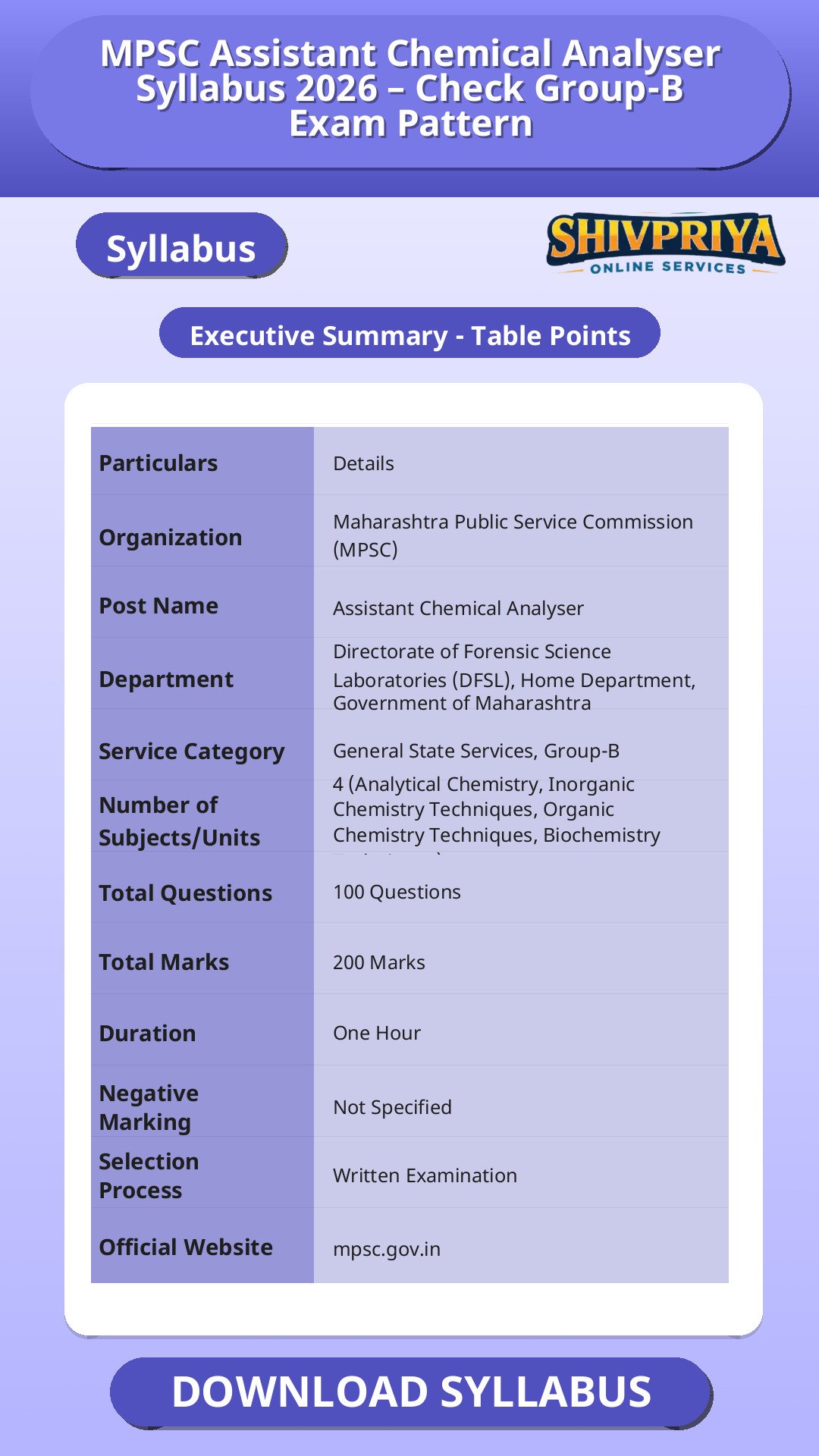
| Particulars | Details |
|---|---|
| Organization | Maharashtra Public Service Commission (MPSC) |
| Post Name | Assistant Chemical Analyser |
| Department | Directorate of Forensic Science Laboratories (DFSL), Home Department, Government of Maharashtra |
| Service Category | General State Services, Group-B |
| Number of Subjects/Units | 4 (Analytical Chemistry, Inorganic Chemistry Techniques, Organic Chemistry Techniques, Biochemistry Techniques) |
| Total Questions | 100 Questions |
| Total Marks | 200 Marks |
| Duration | One Hour |
| Negative Marking | Not Specified |
| Selection Process | Written Examination |
| Official Website | mpsc.gov.in |
📘 Syllabus Summary
Syllabus Summary
The MPSC Assistant Chemical Analyser exam 2026 is conducted by Maharashtra Public Service Commission for recruitment under the Directorate of Forensic Science Laboratories, Government of Maharashtra. The exam pattern consists of a single paper with 100 questions totaling 200 marks, to be completed in one hour. The selection process is based on the written exam performance. The syllabus covers four important subjects: Analytical Chemistry, Analytical Techniques in Inorganic Chemistry, Analytical Techniques in Organic Chemistry, and Analytical Techniques in Biochemistry. Candidates must focus on both theoretical concepts and practical applications of various analytical techniques. Official updates and notifications are available on the MPSC official website mpsc.gov.in.📝 Exam Pattern
Exam Pattern
नीचे MPSC Assistant Chemical Analyser परीक्षा के लिए परीक्षा पैटर्न टेबल में दिया गया है। इस परीक्षा में कुल 100 प्रश्न होंगे जो 200 अंकों के होंगे। परीक्षा की अवधि एक घंटा है। प्रश्न वस्तुनिष्ठ प्रकार के होंगे और चयन केवल लिखित परीक्षा के आधार पर होगा।| Section | Questions | Marks | Duration |
|---|---|---|---|
| Analytical Chemistry, Inorganic Chemistry Techniques, Organic Chemistry Techniques, Biochemistry Techniques | 100 | 200 | 1 Hour |
🎯 Selection Process
Selection Process
महाराष्ट्र लोक सेवा आयोग के तहत असिस्टेंट केमिकल एनालाइजर पद के लिए चयन प्रक्रिया केवल लिखित परीक्षा पर आधारित है। उम्मीदवारों को परीक्षा में प्राप्त अंकों के आधार पर मेरिट सूची तैयार की जाती है। अंतिम चयन में मेरिट और योग्यता को ध्यान में रखा जाता है।📝 Important Topics For The Exam
Important Topics For The Exam
- Analytical Chemistry: Sampling, molarity concepts, calibration, statistical treatment, titrimetry, gravimetric analysis, and separation techniques
- Inorganic Chemistry Techniques: Spectroscopy methods such as AAS, ICP-MS, UV-Visible, ion exchange chromatography, and microscopy techniques like SEM-EDS
- Organic Chemistry Techniques: UV-Visible, IR, NMR spectroscopy, chromatographic separation techniques including TLC, HPLC, GC-MS, and organic analysis of drugs, pesticides, and petroleum products
- Biochemistry Techniques: Biomolecules structure and functions, molecular biology methods (PCR, ELISA), electrophoresis techniques, isotope tracer methods, enzyme kinetics, and biological fluid examination
📑 Preparation Strategy
Preparation Strategy
- सबसे पहले चार मुख्य विषयों को समझते हुए अध्ययन योजना बनाएं और Analytical Chemistry एवं Organic Chemistry पर अधिक समय दें क्योंकि ये अन्य विषयों की नींव हैं।
- विशेष रूप से स्पेक्ट्रोस्कोपी और क्रोमैटोग्राफी उपकरणों के सिद्धांत और अनुप्रयोगों (जैसे ICP-MS, GC-MS, HPLC, SEM-EDS) पर ध्यान केंद्रित करें।
- सांख्यिकीय विश्लेषण जैसे t-test, F-test, मानक विचलन, और विश्वास अंतराल की गणनाओं का अभ्यास करें क्योंकि ये परीक्षा में महत्वपूर्ण होते हैं।
- Biochemistry में अलगाव तकनीकों और इलेक्ट्रोफोरेसिस के नोट्स बनाएं क्योंकि ये फॉरेंसिक जीवविज्ञान से जुड़े हैं।
- पिछले वर्षों के प्रश्नपत्रों का अभ्यास करें ताकि प्रश्नों की कठिनाई और पैटर्न समझा जा सके।
- आधिकारिक MPSC वेबसाइट पर नियमित रूप से अपडेट चेक करें और परीक्षा तिथि व पैटर्न की जानकारी प्राप्त करते रहें।
📑 Recommended Books
Recommended Books
| Subject | Recommended Book | Author / Publication |
|---|---|---|
| Analytical Chemistry | Vogel's Textbook of Quantitative Chemical Analysis | G.H. Jeffery / Pearson |
| Inorganic Chemistry Techniques | Inorganic Chemistry Principles | J.D. Lee / McGraw Hill |
| Organic Chemistry Techniques | Organic Chemistry Spectroscopy | William Kemp / Palgrave |
| Biochemistry | Biochemistry | Voet & Voet / Wiley |
⭐ Important Links
Important Links
| Link Description | Link |
|---|---|
| Syllabus PDF Download | Click Here |
| Official Website (MPSC) | mpsc.gov.in |
| DFSL Maharashtra Official Website | dfsl.maharashtra.gov.in |
📘 Analytical Chemistry Syllabus Details
Analytical Chemistry Syllabus Details
यह अनुभाग Analytical Chemistry के विभिन्न पहलुओं को विस्तार से कवर करता है, जिसमें नमूना संग्रहण, मोलरिटी, सांख्यिकीय विश्लेषण, टिट्रिमेट्री, ग्रेविमेट्री, तथा पृथक्करण तकनीकें शामिल हैं। उम्मीदवारों को प्रत्येक विषय की गहराई से तैयारी करनी चाहिए क्योंकि ये आधारभूत और महत्वपूर्ण विषय हैं। (A) Basic Aspects - Sampling of solid, liquid, and gas samples - Molecular and equivalent weight - Molarity, molality, normality - Solution preparation in w/w, w/v, and v/v terms - Mole concept, concentrations, ppm, ppb, and ppt - Calibration and validation: calibration curve, regression analysis, external standard, internal standard, and standard addition method (B) Statistical Treatment of Results - Accuracy, precision, sensitivity, detection limit - Errors and their types, mean, median, standard deviation, relative standard deviation - Gaussian curve, t-test, F-test, confidence interval - Criteria for selection of analytical methods: accuracy, precision, sensitivity, selectivity, specificity, detection limit (C) Titrimetry - Types of titrations: acid-base, complexometric, redox, precipitation - Standards used for standardisation: primary standard and secondary standard - Potentiometric and conductometric titration and their applications (D) Gravimetric and Thermogravimetric Analysis - Precipitation and different precipitants used in gravimetric analysis - pH requirement for precipitation - Quantitative analysis - Thermogravimetric analysis - Mass spectrometry for qualitative and quantitative analysis, and related problems (E) Separation Techniques - Extraction methods - Distillation methods: vacuum distillation, steam distillation, fractional distillation - Purification and identification of substances📘 Inorganic Chemistry Techniques Syllabus Details
Inorganic Chemistry Techniques Syllabus Details
इस खंड में अकार्बनिक नमूनों के विश्लेषण के लिए प्रयुक्त विभिन्न विश्लेषणात्मक तकनीकों को शामिल किया गया है, जिसमें स्पेक्ट्रोस्कोपी, क्रोमैटोग्राफी, माइक्रोस्कोपी और इलेक्ट्रोएनालिटिकल तकनीकें शामिल हैं। (A) Spectroscopy and Chromatography for Inorganic Sample Analysis - Atomic absorption, atomic emission, and inductively coupled plasma-atomic emission and mass spectrometry (ICP-AES and ICP-MS) - UV-Visible spectroscopy for qualitative and quantitative analysis, Job's Method, and applications - Ion exchange chromatography for analysis of various inorganic cations and anions (B) Microscopy for Inorganic Sample Analysis - Trace and heavy metal, glass, soil, and liquid sample analysis using Scanning Electron Microscopy (SEM) - Energy Dispersive Spectroscopy (EDS) (C) Electroanalytical Techniques - Coulometry and its types - Amperometry, voltammetry, cyclic voltammetry, stripping voltammetry - Polarography📘 Organic Chemistry Techniques Syllabus Details
Organic Chemistry Techniques Syllabus Details
यह अनुभाग ऑर्गेनिक केमिस्ट्री के विश्लेषणात्मक तकनीकों को कवर करता है जिसमें स्पेक्ट्रोस्कोपी के सिद्धांत और अनुप्रयोग, विभाजन तकनीकें और विभिन्न प्रकार के कार्बनिक पदार्थों का विश्लेषण शामिल है। (A) Spectroscopy - Theory and application of UV-Visible, IR (FTIR), Raman, NMR, and Mass spectrometry - Interpretation of spectra and structure elucidation (B) Separation Techniques - Theory and application in chemical analysis of TLC, HPTLC, GC, GC-MS, LC-MS, HRMS, column chromatography, and paper chromatography - HPLC: ion exchange chromatography, adsorption chromatography, normal and reverse phase chromatography, solid phase extraction (C) Organic Analysis - Pharmaceutical and narcotic drugs, psychotropic substances - Alcohol estimation - Petroleum products, paints and dyes, rubber, plastic, fibres - Organic poisons such as insecticides, pesticides, herbicides, etc.📘 Biochemistry Techniques Syllabus Details
Biochemistry Techniques Syllabus Details
यह खंड बायोकेमिस्ट्री से संबंधित विश्लेषणात्मक तकनीकों को समेटता है, जिसमें बायोमोलेक्यूल्स, आणविक जीवविज्ञान, अलगाव तकनीकें, आइसोटोप ट्रेसर तकनीकें, एंजाइम अध्ययन तथा जैविक द्रवों और बाल परीक्षण शामिल हैं। (A) Biomolecules - Structure, functions, and estimation of carbohydrates, lipids, proteins, nucleic acids - Biological buffers (B) Molecular Biology - DNA isolation, DNA quantification - PCR, RT-PCR, RFLP (Restriction Fragment Length Polymorphism) - ELISA, RIA (Radio Immuno Assay) - Antigen-antibody reactions (C) Separation Techniques - SDS-PAGE, one dimension (PAGE) and two dimension electrophoresis - Isoelectric focusing - Gel filtration chromatography, affinity chromatography - High voltage electrophoresis, agarose electrophoresis, capillary electrophoresis (D) Isotope Tracer Technique - Basic concepts and principles - Advantages, limitations, and applications in biochemistry (E) Enzymes - Enzyme classification, isoenzymes - DNA polymerase - Enzyme kinetics (basic) (F) Blood and Other Body Fluid and Hair Examination (Human and Animal) - Blood group system - Semen examination, saliva, urine, hair, sweat - Biological stains and their preservation📑 Faqs
FAQs
- Q1. What is the MPSC Assistant Chemical Analyser syllabus 2026?
- The syllabus covers four units: Analytical Chemistry, Analytical Techniques in Inorganic Chemistry, Analytical Techniques in Organic Chemistry, and Analytical Techniques in Biochemistry. Full topic-wise details are given above.
- Q2. Where can I download the MPSC Assistant Chemical Analyser syllabus PDF?
- The syllabus PDF can be downloaded from the official MPSC website. The direct link will be added here once the official PDF URL is available.
- Q3. Which department conducts the Assistant Chemical Analyser recruitment?
- The post falls under the Directorate of Forensic Science Laboratories (DFSL), Home Department, Government of Maharashtra, and is classified under General State Services, Group-B.
- Q4. How many questions and marks are there in the MPSC Assistant Chemical Analyser exam?
- The exam consists of 100 questions carrying a total of 200 marks.
- Q5. Is there any negative marking in the exam?
- Negative marking details are not specified in the official syllabus document.
📑 People Also Ask
People Also Ask
- What is the duration of the MPSC Assistant Chemical Analyser exam?
- Which topics have the highest weightage in the Assistant Chemical Analyser syllabus?
- How can I prepare effectively for the Biochemistry section of the exam?
- Where can I find previous year question papers for this exam?
- Is practical knowledge of analytical instruments necessary for the exam?
⚠️ Disclaimer
Disclaimer
Yeh job post sirf informational purpose ke liye banayi gayi hai taaki aapko recruitment ki details simple aur samajhne layak format me mil sake.
Time ke saath details me changes ho sakte hain (jaise dates, vacancies, eligibility, etc.). Isliye apply karne se pehle official notification ko zarur verify karein.
Hum kisi bhi typing error, outdated information ya misunderstanding ke liye zimmedar nahi honge.
🔗 Related Jobs
- Ratnagiri District Court Contractual Employee Recruitment 2026 – Apply Offline
- IIT Roorkee Junior Research Fellow Recruitment 2026 – Apply Now
- IIT BHU Junior Research Assistant Recruitment 2026 – Apply Now for 1 Post
- Comprehensive Guide to BFUHS BSc Paramedical & Nursing Results 2026
- BEML Non Executive Recruitment 2026: Apply Online for 10 Tenure Posts
- Complete Guide to NEHU History 2nd Semester Result 2026 Download and Details

